


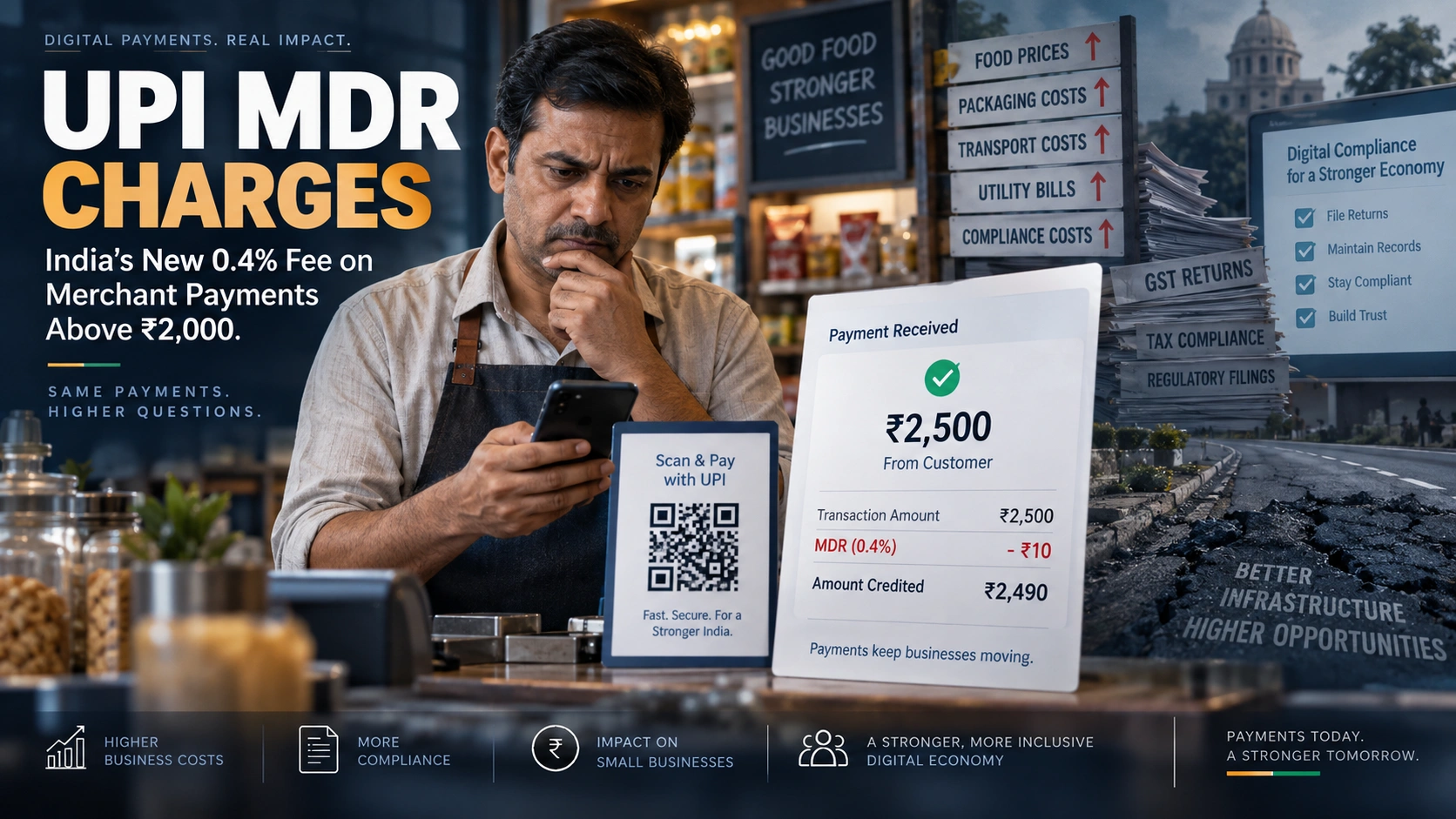
UPI MDR charges are about to change a habit that India adopted faster than almost any other financial behaviour.
For years, a customer could buy vegetables, pay a salon bill, settle a tuition fee, purchase a laptop, or make a business payment simply by scanning a QR code. For the merchant, the money arrived quickly. For the customer, the transaction felt free. For the economy, it looked like a rare success story where convenience, adoption, and digital inclusion moved together.
Now the arrangement has changed.
From 15 October 2026, eligible UPI merchant payments above ₹2,000 will attract a 0.4% Merchant Discount Rate, commonly called MDR. The charge will apply to specified person-to-merchant UPI transactions. Payments up to ₹2,000 will remain free from MDR, while transactions of ₹75,000 or more will have the MDR capped at ₹300. Read the reported NPCI UPI MDR framework
At first glance, it sounds like a small cost. A merchant receiving ₹2,500 through UPI may pay ₹10. A ₹10,000 transaction may lead to an MDR of ₹40. A ₹50,000 transaction may result in ₹200 of UPI merchant payment charges.
That sounds manageable. But that is how most financial burdens enter business life. They rarely arrive as one alarming invoice. They arrive as a small new deduction, a revised compliance rule, a new cess, a threshold, a processing fee, a filing condition, or a platform charge. Each one looks harmless alone. Together, they change the economics of operating a business.
The UPI MDR charges debate is therefore not about whether payment infrastructure has a cost. It does. The debate is about whether India should impose another cost on merchants who are already formal, visible, taxable, compliant, and increasingly dependent on digital payment systems.
What Are UPI MDR Charges?
UPI MDR charges refer to the Merchant Discount Rate deducted from eligible merchant payments made through the Unified Payments Interface.
MDR is not charged to the customer directly. It is charged to the merchant receiving the payment. The payment ecosystem may distribute the collected amount among participating entities such as acquiring banks, payment service providers, and other payment infrastructure participants.
That distinction matters.
A customer may be told that UPI remains free. Technically, that is true for the customer. But businesses do not operate outside the economy. When merchants pay more to collect money, they may eventually absorb the cost through lower margins, smaller discounts, reduced staffing flexibility, higher product prices, or slower investment.
The charge has not vanished simply because it is not visible on the customer’s phone screen.
The current framework reportedly includes the following structure:
|
UPI transaction type |
UPI MDR charges |
|---|---|
|
Person-to-person UPI transfer |
No MDR |
|
Merchant UPI payment up to ₹2,000 |
No MDR |
|
Eligible UPI merchant payment above ₹2,000 |
0.4% MDR |
|
Eligible payment of ₹75,000 or more |
MDR capped at ₹300 |
|
Designated small P2PM merchant |
Zero MDR |
|
Certain categories such as railways, telecom, insurance and fuel |
Flat ₹5 MDR for applicable payments above ₹2,000 |
|
Mutual funds, securities, brokers and dealers |
0.02% MDR, subject to a cap |
Reports indicate that the new MDR framework defines small merchants under the P2PM category as those receiving up to ₹1 lakh per month through UPI QR codes. Read the small-merchant threshold and MDR details
This is where the first hard question begins.
Is ₹1 Lakh a Month Really a Small-Merchant Threshold?
A merchant receiving ₹1 lakh per month is not automatically prosperous.
That ₹1 lakh is usually turnover or gross collections. It is not income. It is not profit. It is not spare money waiting to be taxed or charged.
A small business earning ₹1 lakh in monthly receipts may still have to pay for:
Take a small salon in Pune, a coaching centre in Lucknow, a home-furnishing store in Ahmedabad, a clinic in Indore, or a local electronics seller in Bengaluru. Each can cross ₹1 lakh in UPI collections without becoming a “large merchant” in any practical sense.
A tuition centre receiving ten monthly student payments of ₹5,000 has already received ₹50,000. Add a few new admissions or annual fee instalments and it may cross the threshold quickly. A clinic that receives consultation and treatment payments can cross ₹1 lakh in a few working days. A small B2B service provider may receive fewer payments but each invoice could exceed ₹2,000.
The threshold does not measure financial comfort. It measures visibility.
And when a business becomes visible through digital transactions, GST registration, invoices, bank records, and QR-code collections, it also becomes easier to regulate, monitor, and charge. That is why UPI MDR charges cannot be discussed only as a payment-processing issue. They are part of a wider question about how the cost of governance is distributed.
The 0.4% Number Is Not the Whole Story
The government and payment ecosystem may reasonably argue that 0.4% is lower than typical card payment charges.
That is true.
Credit card MDR can be significantly higher, often ranging around 1.5% to 2.5%, depending on card type, merchant category, and payment arrangement. Debit card MDR is also regulated differently. In that narrow comparison, the proposed UPI MDR charges are lower.
But lower than an expensive alternative does not automatically make a new charge fair.
UPI did not become India’s most widely used payment mechanism because it competed only with credit cards. It became popular because it created a near-frictionless alternative to cash.
A merchant could print a QR code, place it near the counter, and accept money without investing in a card terminal. A customer could pay without cash, change, card details, or a point-of-sale machine. A small trader could start accepting digital payments within minutes.
That model changed commercial behaviour.
Now the question is whether the success of that model is being treated as an opportunity to collect more from the businesses that helped make it universal.
Reports suggest that the 0.4% MDR could generate as much as ₹16,000 crore in annual revenue for the payment ecosystem. Read the reported annual revenue estimate for UPI MDR
Even if that estimate changes with transaction patterns, exemptions, and merchant classification, it illustrates the scale of the policy. This is not a symbolic adjustment. It creates a potentially large revenue stream attached to commercial digital payments.
That is why the public should ask what protections exist against future expansion.
Will the 0.4% rate remain fixed?
Will the ₹2,000 threshold remain fixed?
Will the ₹1 lakh small-merchant exemption be revised upward for inflation and rising operating costs?
Will the list of affected merchant categories grow?
Will banks, payment aggregators, and fintech firms add separate fees around the UPI MDR framework?
None of these changes has been formally announced. It would be incorrect to say they have.
But Indian financial history shows why businesses should not dismiss such questions.
India’s Financial Snowball Effect
India has seen several examples where a levy began with a limited rate or narrow scope and later grew through higher rates, wider coverage, additional cesses, or more categories.
This does not mean every levy necessarily follows the same path. Governments have also reduced and withdrawn taxes in some cases. But the historical record makes caution rational.
Service Tax: From Three Services to a Broad Burden
Service tax began in 1994 at 5% and was initially imposed on only three services:
- Telephone services
- Stockbroking services
- General insurance services
It looked narrow. Then the rate began to move.
The Department of Revenue’s history of service tax records the progression from 5% to 8% in 2003, then to 10% in 2004, and to 12% in 2006. Later, the effective burden rose further through education-related cesses and other additions. Read the Department of Revenue service tax history
Before GST absorbed service tax in 2017, the effective rate had reached 15%, including:
- 14% service tax
- 0.5% Swachh Bharat Cess
- 0.5% Krishi Kalyan Cess
The tax base also expanded from three services to more than 120 service categories.
There is a lesson here for every business owner.
- A policy does not need to begin large to become significant. It simply needs a legal and administrative foothold.
Once businesses change their accounting systems, billing methods, compliance processes, invoices, contracts, and pricing to accommodate a charge, the cost becomes normalised. Once normalised, revising its rate or coverage becomes easier than introducing a new levy from scratch.
That is the snowball effect.
Education Cess: A Dedicated Charge That Grew
Education cess began at 2% in FY 2004-05. The stated goal was to fund elementary education and the Mid-Day Meal Scheme. In FY 2007-08, an additional 1% secondary and higher education cess was introduced.
Then, from FY 2018-19, the earlier 3% education-related cess was replaced by a 4% Health and Education Cess. Read the official parliamentary response on cess changes
Education and healthcare are important public priorities. Nobody should argue otherwise. But the policy pattern remains relevant. A levy introduced for a clearly defined public objective can continue, expand in purpose, and increase in percentage over time.
The citizen pays it as part of an already layered tax burden. The ordinary taxpayer often has little ability to see a direct, measurable relationship between the amount collected and the quality of public services received.
That lack of transparency is why a new UPI charge invites distrust.
Securities Transaction Tax: Charges on Financial Activity Can Rise
Securities Transaction Tax, or STT, was introduced in 2004 on transactions in listed securities carried out through recognised stock exchanges.
Soon after its introduction, rates were increased across multiple transaction categories. The Income Tax Department’s own circular explained that higher STT rates were introduced to mobilise additional resources and plug revenue leakages. Read the official circular on STT rate increases
STT has seen both increases and reductions across different market segments over the years. That nuance matters. The history is not a straight line upward.
But the larger point remains: once a charge is attached to a financial transaction, governments retain the ability to revise it by product, transaction type, category, or policy objective.
The Finance Act 2026 increased STT on certain futures and options transactions, again showing that transaction-level levies can be recalibrated when the government decides to do so. Review current STT changes for derivatives
UPI MDR charges should be examined through the same lens.
A payment rail that begins with a 0.4% charge for certain merchant transactions can, in theory, later have a revised rate, lower threshold, expanded applicability, or additional category-specific pricing.
The point is not to predict it as fact. The point is to demand safeguards before the system settles into place.
Equalisation Levy: The Digital Tax Expansion
India’s equalisation levy is another example from the digital economy.
It was introduced by the Finance Act 2016 on payments for online advertising services, digital advertising space, and related online facilities provided by non-residents.
In 2020, its scope expanded to cover e-commerce supply and services made, provided, or facilitated by non-resident e-commerce operators. Read the Income Tax Department’s explanation of equalisation levy scope
The levy later went through policy changes, including phase-out measures. That is important because it proves that tax expansions are not irreversible.
But the story still illustrates how quickly a narrow digital levy can broaden when the economy shifts online and the transaction trail becomes easier to monitor.
UPI MDR charges exist in the same broad environment: a digital economy where business activity is traceable, measurable, and simple to charge at the point of transaction.
Why the Ashneer Grover Criticism Resonates
Ashneer Grover’s criticism of the new UPI framework struck a chord because it named the discomfort many merchants feel.
He argued that any levy on UPI should be called what it is: a form of collection from the payment ecosystem, rather than a harmless technical adjustment. He also warned that UPI is among India’s most visible technology successes and that damaging its universal ease of use would be a serious mistake. Read the reported Ashneer Grover comments on UPI MDR
The strongest version of his argument is not that payment infrastructure should receive no funding. The strongest argument is this:
If the country has decided that UPI is national digital infrastructure, then the public deserves a transparent explanation of its operating costs, funding gap, revenue distribution, merchant impact, and future fee commitments.
A merchant should not have to guess whether today’s 0.4% will remain 0.4%.
And a small business should not have to fear that crossing ₹1 lakh in monthly UPI receipts is the point at which a supposedly digital-inclusion-friendly system starts treating growth as a source of extraction.
When Large Financial Failures Meet Small Business Levies
The anger around UPI MDR charges grows sharper because it exists alongside India’s long history of large bank frauds, bad loans, delayed recoveries, and high-profile financial wrongdoing. It is essential to distinguish between a business default, a stressed loan, and proven fraud. Not every large borrower is a fraudster. Not every corporate failure is caused by misconduct.
But India has had major cases involving allegations of fraud against banks, including cases associated with Vijay Mallya, Nirav Modi, Mehul Choksi, and other high-profile business figures. These cases have involved investigations, prosecutions, asset attachments, recovery proceedings, and lengthy legal processes.
The public concern is not that enforcement never happens. The public concern is that enforcement often appears slow, fragmented, and uncertain after enormous amounts have already been exposed.
RBI-reported data showed that banks recorded approximately 23,953 fraud cases involving ₹36,014 crore in FY 2024-25. The number of reported cases declined from the prior year, but the amount involved rose sharply. Read reported RBI figures on bank frauds in FY 2024-25
This creates a difficult contrast.
A small business may face a notice for a GST mismatch. A merchant may spend days fixing a registration issue. A founder may receive a portal rejection because a document was uploaded in the wrong format. A taxpayer may be charged interest for a late payment.
At the same time, the public reads about large-value frauds, prolonged recoveries, loan write-offs, insolvency proceedings, and investigations that stretch across years.
The resulting question is not unreasonable:
Why is the state so capable of identifying, charging, and enforcing against small visible businesses, but repeatedly unable to prevent large financial losses before they reach massive proportions?
A better financial system would not choose between enforcement against large fraud and compliance from small businesses. It would do both. But when government policy introduces UPI MDR charges while the public still sees huge bank-fraud figures, the fairness of the burden becomes impossible to ignore.
Tax Relief for Large Companies Versus New Merchant Costs
The 2019 corporate tax reduction remains another important part of this discussion.
The government lowered the base corporate tax rate for domestic companies to 22%, subject to specified conditions, and introduced a 15% base tax rate for eligible new domestic manufacturing companies.
The government estimated revenue foregone from the rate cut and related relief at ₹1.45 lakh crore per year. Read the official announcement on corporate tax relief
There are valid arguments for corporate tax relief. Lower tax rates can support investment, manufacturing, employment, competitiveness, and business expansion. A tax cut is not automatically a favour to the wealthy.
But the contrast matters.
If the government can forgo ₹1.45 lakh crore annually in corporate tax relief to stimulate the economy, it is fair to ask why merchants processing higher-value UPI payments should now be asked to contribute through a new MDR framework.
A merchant receiving ₹1 lakh in a month is not necessarily comparable to a large company benefiting from corporate tax reform. One may be managing rent, staff salaries, inventory, GST, customer credit, delayed payments, and family expenses. The other may have access to larger capital pools, tax advisors, institutional investors, and balance-sheet capacity.
This does not mean large businesses should be punished. It means small and growing businesses should not become the default answer every time the state needs a new revenue channel.
PM CARES and the Public Demand for Transparency
The PM CARES Fund was established during the COVID-19 emergency for relief and preparedness. Asking questions about PM CARES does not imply wrongdoing. It is about transparency, governance, and public confidence.
The government has maintained that PM CARES is a public charitable trust and not a public authority under the Right to Information Act. It has not been treated as subject to RTI requirements in the same way as a government department. The fund has been audited by a chartered accountant rather than directly by the Comptroller and Auditor General of India. Read the background on PM CARES transparency and audit questions
The public is entitled to ask reasonable questions:
These questions are not anti-government. They are pro-accountability.
The same principle applies to UPI MDR charges. If merchants are asked to contribute to payment infrastructure, they should know exactly where the money goes, who receives it, what it funds, how it improves payment acceptance, and what prevents new charges from being added later.
Government Levies Versus Everyday Public Services
No government delivers perfect roads, portals, railways, hospitals, or public services. That is not the standard.
The standard is whether citizens and businesses receive reasonable value, responsiveness, and accountability in exchange for the taxes, cesses, fees, tolls, charges, and compliance burdens they bear.
For many people, that relationship feels strained.
Roads, Taxes, and Repeated Repairs
India has expanded its road network significantly. Yet daily experience often tells a different story.
Motorists pay fuel taxes, vehicle taxes, registration charges, insurance, tolls, parking charges, and local levies. Still, many cities experience roads that are repeatedly dug up, poorly restored, badly drained, uneven, unsafe, and damaged after monsoon seasons.
CAG audit reporting repeatedly examines public works responsibilities relating to road quality, connectivity, upgrades, and periodic maintenance. Review CAG audit coverage of road quality and maintenance
The issue is not only construction. It is lifecycle management.
A road does not become useful because it was inaugurated. It becomes useful when it survives rain, traffic, utility work, emergency access needs, pedestrian movement, and years of regular use.
When public systems fail at basic maintenance, citizens question every additional levy. They ask why collection is immediate but repair is delayed.
Business Portals: Digital India, Manual Frustration
For entrepreneurs, the most exhausting part of compliance is often not the law. It is the portal.
A new business may need to interact with different government systems for:
Each system can have different credentials, user interfaces, browser behaviour, document specifications, filing windows, OTP issues, error codes, downtime, and escalation procedures.
In practice, businesses often have to maintain a compliance calendar simply to avoid missing deadlines created by platform complexity rather than business complexity.
CAG audits have identified weaknesses in the GST Network, including gaps in validation, incorrect data capture, and delays in underlying processes. Read CAG observations on GSTN data and process gaps
Earlier CAG findings also highlighted that some GST registration validations were not aligned with legal provisions and that important data checks were missing. Review CAG findings on GST registration-system gaps
This is not a minor inconvenience.
For a founder, a portal failure can delay:
Businesses lose working hours, professional fees, opportunities, and peace of mind. Yet when the same business makes a minor filing delay, the system can be quick to apply interest, penalty, or procedural friction.
That imbalance explains why merchants are sceptical of another payment-related charge.
IRCTC: A Public Platform That Keeps Testing Patience
IRCTC is another example of the difference between a public service in theory and a public experience in reality.
For millions of passengers, especially those booking Tatkal tickets, the IRCTC website and app are not optional conveniences. They are essential booking channels during time-sensitive situations Yet users have repeatedly reported login failures, payment issues, booking errors, session timeouts, slow pages, and outages during peak Tatkal booking windows.
Reports documented problems during Tatkal booking in October 2025, followed by repeated complaints and error messages in December 2025. Read reporting on repeated IRCTC Tatkal booking problems
More recent reports have also described login and booking difficulties affecting both the IRCTC app and website. Read recent reporting on IRCTC service issues
The usual user response is familiar:
But a Tatkal ticket is not an online shopping cart. It can determine whether a person reaches an exam, job interview, hospital, family emergency, court hearing, workplace, or university.
A failure during a narrow booking window cannot always be solved with a support ticket.
Private platforms can lose customers when they fail. A public platform often has captive users with no equal alternative. That makes reliability a public obligation, not merely a technical target.
If citizens face recurring digital-service failures while being asked to accept new digital transaction charges, their frustration is not irrational. It is based on lived experience.
What Businesses Should Do About UPI MDR Charges
Criticism should not stop at criticism. Businesses should prepare with data.
Audit UPI Payment Behaviour
Review the last six to twelve months of collections and categorise payments by value:
This will reveal whether UPI MDR charges are likely to be marginal or material for your business.
Calculate Real Collection Cost
Do not look only at MDR.
Your actual cost of collecting revenue may include:
A business can grow revenue and still lose margin if collection costs are invisible.
Improve Payment Reconciliation
When MDR starts affecting merchant settlements, gross sales will not always match the amount that lands in the bank account.
Businesses need to reconcile:
For growing businesses, financial-services support from Panthak can help structure payment reconciliation, cash-flow reporting, accounting controls, compliance processes, and financial decision-making without turning every small deduction into a month-end surprise.
Do Not Add Customer Fees Without Checking First
Some businesses may consider passing UPI MDR charges directly to customers.
That approach should not be taken casually.
Before adding a convenience fee or surcharge, review payment-provider agreements, consumer expectations, applicable rules, competitor practices, and reputational consequences. A ₹10 fee may cost more in lost trust than it saves in MDR.
The smarter approach is to understand margins, price products properly, reduce operational leakage, and choose payment methods strategically.
The Case for Stronger Guardrails
If UPI MDR charges are being introduced as a sustainable payment-infrastructure measure, then merchants deserve firm guardrails.
A reasonable public framework should include:
These are not unreasonable demands.
Businesses are expected to maintain books, issue invoices, retain records, file returns, accept scrutiny, and explain every mismatch. Payment infrastructure that collects money from those businesses should be held to the same standard of transparency.
The Real Question Behind UPI MDR Charges
UPI MDR charges are not just about 0.4%. They are about trust.
Can small businesses trust that a limited charge will remain limited?
Can merchants trust that payment infrastructure revenue will be used transparently?
Can taxpayers trust that large frauds, leakages, and inefficiencies will receive the same urgency as minor compliance gaps?
Can entrepreneurs trust that government portals, roads, public booking platforms, and compliance systems will improve at the same pace at which new charges are created?
India’s digital-payment revolution deserves protection. UPI has created real convenience, wider access, faster collections, and a powerful digital habit across every layer of commerce. But a successful public payment system should not become another place where the smallest compliant business is asked to absorb the next cost.
The right response is not panic. It is scrutiny, preparation, transparency, and a demand for balance. Before accepting new UPI merchant payment charges as inevitable, every business owner should ask one simple question:
If the cost of receiving money is rising, are the systems funded by our taxes, fees, and compliance burden improving at the same speed?
For business owners who want clearer answers around cash flow, payment reconciliation, accounting discipline, tax planning, and financial control, is it worth exploring how Panthak’s financial services can help turn everyday collections into a stronger business finance system?