

Financial compliance for businesses in Pune is not a back-office problem you can defer until tax season. GST filings, TDS deductions, PF contributions, ESIC, professional tax, advance tax. The list does not shorten as your business grows. It compounds.
This guide is written for business owners in Pune who are either just starting out and unsure of their obligations, or have been operating for a few years and know something is off but cannot pinpoint what.
Why Financial Compliance for Businesses in Pune Costs More When Ignored
Most founders treat compliance as a back-office problem. Something for the accountant to handle. The trouble is, when the accountant is a part-timer, a freelancer handling twelve other clients, or simply not up to date with the latest circulars, the penalties land on your business, not theirs.
Late GST filings attract a late fee of Rs. 50 per day per return (Rs. 20 per day for nil returns), which sounds minor until you are carrying 18 months of backlogs across multiple GSTINs. TDS defaults carry a 1.5% per month interest charge on the amount not deposited. Payroll non-compliance under PF and ESIC can trigger inspection notices, employee grievances, and in serious cases, prosecution proceedings.
A multi-location retail business in Pune that came to Panthak had accumulated three years of backlogged GST filings and mounting penalties across their locations. The clean-up took 45 days. The penalty reduction was 90%. The time lost and the stress of operating under that cloud, those are costs no spreadsheet captures cleanly.
Prevention is always cheaper than recovery.
GST Compliance: What Every Pune Business Needs to Get Right
Who Needs to Register
If your aggregate annual turnover exceeds Rs. 40 lakhs for goods (Rs. 20 lakhs for services, Rs. 10 lakhs for special category states), GST registration is mandatory. In Pune, where most SMEs and service businesses cross the Rs. 20 lakh threshold within the first year of operations, this means registration is rarely optional for an established business.
Voluntary registration below the threshold is also worth considering if your clients are GST-registered businesses, since it allows you to charge GST and pass input tax credit to your buyers, which many B2B buyers actively require.
The Filing Calendar You Need to Follow
GSTR-1 (outward supplies): Filed monthly by the 11th of the following month for businesses with turnover above Rs. 5 crore. Quarterly for those below (QRMP scheme), due by the 13th of the month following the quarter.
GSTR-3B (summary return and tax payment): Monthly by the 20th for businesses above Rs. 5 crore. For QRMP filers, by the 22nd or 24th depending on your state category. Maharashtra falls in the 20th category.
GSTR-9 (annual return): Due by 31st December of the following financial year. Compulsory for businesses with turnover above Rs. 2 crore.
GSTR-9C (reconciliation statement): Required for businesses with turnover above Rs. 5 crore, certified by a CA or CMA.
Missing any of these does not just trigger late fees. It blocks your buyers from claiming input tax credit on your supplies, which can damage client relationships faster than a missed delivery.
The Input Tax Credit Problem Most Businesses Miss
Input Tax Credit (ITC) is one of the biggest cash flow tools available to GST-registered businesses, and one of the most consistently mismanaged. ITC allows you to offset the GST you have paid on purchases and expenses against the GST you owe on sales. Done correctly, this can significantly reduce your net tax outflow every month.
Done incorrectly, or not done at all, it is free money left on the table. Panthak’s engagements have repeatedly found that the first month of proper ITC reconciliation recovers more in missed credits than the cost of a quarterly advisory retainer.
The conditions for claiming ITC: the supplier must have filed their GSTR-1, the invoice must appear in your GSTR-2B, the goods or services must have been received, and payment must be made within 180 days of the invoice date. Each of these conditions requires active monitoring, not a quarterly review.
For the official GST filing portal and updated return forms, visit gstn.org.in.
TDS Compliance: The Obligation That Catches Most Business Owners Off Guard
Tax Deducted at Source is not just for salaried employees. If your business makes payments above specified thresholds to contractors, professionals, rent payees, or vendors, you are likely a TDS deductor, with all the obligations that come with it.
Key TDS Sections Every Pune Business Should Know
Section 194C (payments to contractors): TDS at 1% for individuals and HUFs, 2% for others, on payments above Rs. 30,000 per transaction or Rs. 1 lakh aggregate in a year.
Section 194J (professional or technical services): 10% TDS on payments to doctors, lawyers, consultants, and technical service providers above Rs. 30,000 per year.
Section 194I (rent): 10% TDS on rent payments above Rs. 2.4 lakhs per year for land, building, and furniture; 2% for plant and machinery.
Section 192 (salary): TDS deducted monthly based on the projected annual salary and applicable income tax slab of each employee.
The TDS Compliance Cycle
Deduct at the time of payment or credit, whichever is earlier. Deposit by the 7th of the following month (except March, where the deadline is 30th April). File quarterly TDS returns: Form 24Q for salary, Form 26Q for non-salary payments. Issue TDS certificates (Form 16 for employees, Form 16A for others) within the stipulated timelines after each quarter.
A common mistake among Pune MSMEs: paying vendors in full without deducting TDS, then trying to adjust it in the next payment. This creates a default for the period in between, attracting interest at 1.5% per month from the date deduction should have been made. It is an easy mistake to make and an expensive one to carry.
Consequences of TDS Defaults
Interest on late deduction: 1% per month from when tax should have been deducted to when it was actually deducted.
Interest on late deposit: 1.5% per month from deduction date to deposit date.
Penalty under Section 271C: Up to the amount of TDS not deducted, at the discretion of the assessing officer.
Disallowance of expenses: Expenditure on which TDS was not deducted is disallowed as a deduction in your income tax computation, effectively increasing your taxable income.
Payroll Compliance: The Three Pillars Every Employer in Pune Must Manage
If you have employees on payroll, you are operating under three parallel compliance frameworks simultaneously. Missing any one of them creates liability.
Provident Fund (PF)
Mandatory for establishments with 20 or more employees. Once PF is applicable, it applies to all employees, and opting out is not a straightforward process. Employer contribution is 12% of basic salary (plus DA). Employee contribution is an equal 12%, deducted from salary.
PF payment is due by the 15th of the following month. Late payment attracts damages ranging from 5% to 25% per annum depending on the delay period, in addition to interest at 12% per annum.
Many Pune startups delay PF registration because they are growing fast and do not want the administrative overhead. The moment you cross 20 employees, however, the obligation is retroactive to that date, not the date you register. Getting this wrong is significantly more expensive than getting it right on time.
The EPFO’s official registration and compliance portal is available at epfindia.gov.in
ESIC (Employee State Insurance Corporation)
Applicable for establishments with 10 or more employees. Covers employees earning up to Rs. 21,000 per month (Rs. 25,000 for those with disabilities). Employer contribution is 3.25% of gross wages. Employee contribution is 0.75%.
Payment by the 15th of the following month. Non-compliance carries prosecution risk beyond just financial penalties, which is why this is one of the obligations most business owners regret ignoring.
Professional Tax
Maharashtra levies professional tax on salaried employees. The employer deducts it from the employee’s salary and remits it to the state government. The maximum liability is Rs. 2,500 per year per employee. Enrollment and registration with the Maharashtra State Tax Department are mandatory for every employer operating in Pune.
While professional tax seems minor in isolation, it is a common trigger for labor department inspections when businesses are flagged for other non-compliance issues. Keeping it clean costs almost nothing. Letting it lapse creates unnecessary exposure.
Advance Tax: The Obligation That Surprises Growing Businesses
If your estimated tax liability for the year exceeds Rs. 10,000, you are required to pay advance tax in four installments:
15% by 15th June, 45% by 15th September, 75% by 15th December, and 100% by 15th March.
Failure to pay or underpayment attracts interest under Sections 234B and 234C at 1% per month. For businesses that have had a good year and have not planned for it, the March advance tax deadline combined with the GST filing and TDS deposit that fall in the same month can create a significant cash crunch.
Planning for advance tax requires a reasonably accurate mid-year profit estimate, which is exactly what a well-maintained monthly MIS and virtual CFO oversight provides.
Building a Financial Compliance Calendar for Your Pune Business
The single most effective change any Pune business can make immediately is to build a 12-month compliance calendar with every deadline mapped and a responsible person assigned to each one. This does not require expensive software. A shared Google Sheet with automated reminders is sufficient to start.
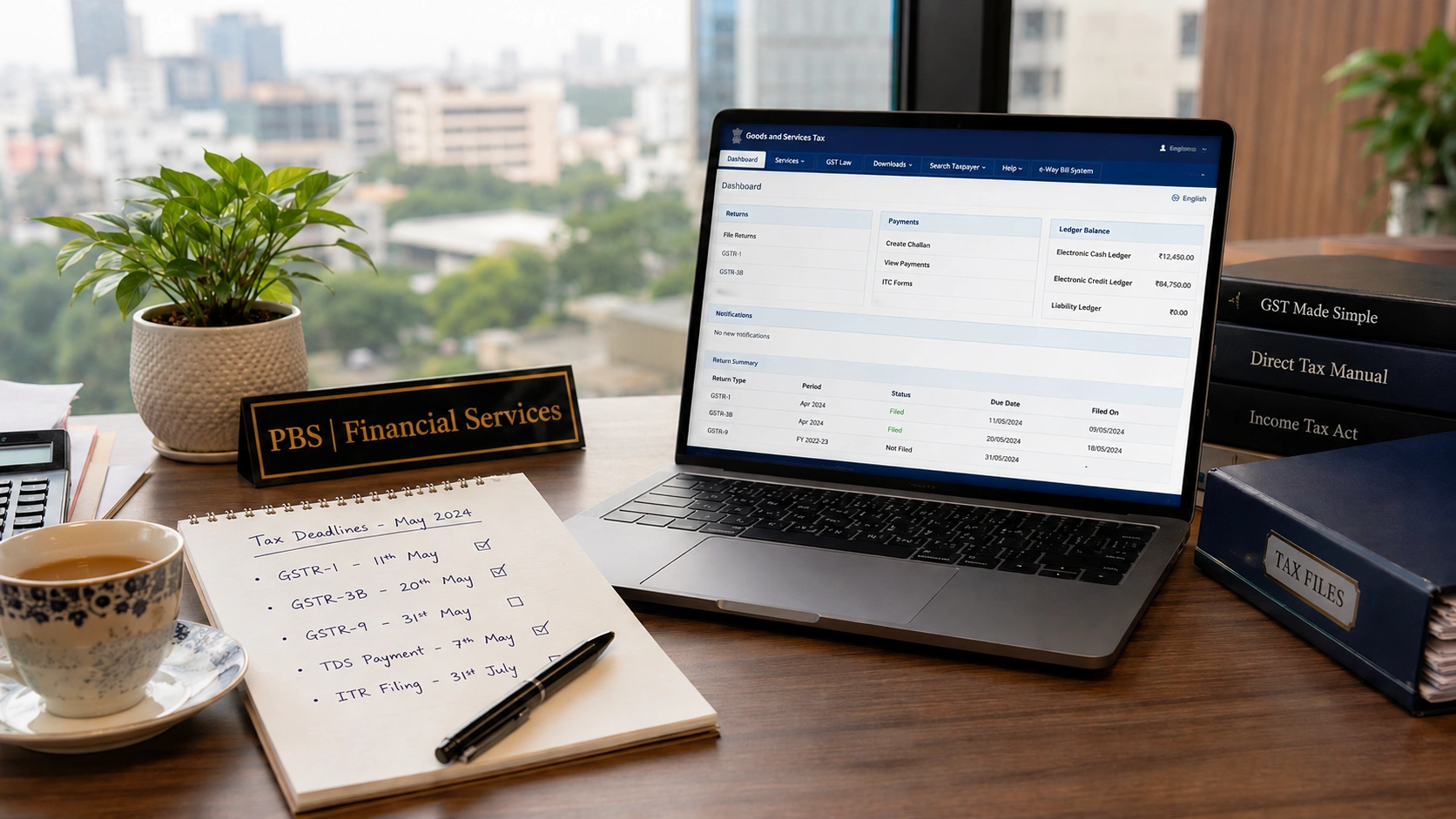
The calendar should cover at minimum: all GSTR-1 and GSTR-3B due dates, TDS deposit dates (7th of every month), TDS return filing dates (quarterly), PF and ESIC payment dates (15th of every month), advance tax installment dates, professional tax payment dates, and the ITR filing deadline for your entity type.
Once every obligation is visible in one place, missed deadlines become a choice rather than an oversight. Most compliance failures are not intentional. They are a product of running a business without a system.
When DIY Compliance Starts Costing More Than It Saves
Handling compliance yourself, or with a junior accountant, works up to a point. That point is usually around Rs. 50 lakhs in annual turnover, or the moment you add a second location, take on your first B2B client who scrutinizes your GST filings, or start thinking about raising capital.
Beyond that point, the complexity of managing multiple GST registrations, maintaining consistent ITC reconciliation, running payroll across different employee categories, and keeping books clean enough for an investor or auditor, requires a level of attention that a part-time resource simply cannot provide.
This is where a managed financial advisory engagement, with a dedicated compliance team and a virtual CFO for strategic oversight, pays for itself quickly. Panthak’s clients in Pune have seen an average annual saving of Rs. 4 lakhs per year through cost optimization and tax efficiency alone, separate from the penalty reduction and compliance certainty that comes with the engagement.
If you are at the stage where compliance is reactive rather than planned, that is the signal. Not a crisis yet, but the direction it is heading.
A Note on Choosing the Right Financial Partner in Pune
Not every CA firm or accounting service offers the same level of engagement. Many handle filings reactively: you send documents, they file returns, they send an invoice. This is compliance as a commodity service, and it is fine for businesses with simple structures and clean operations.
If your business is growing, has multiple revenue streams, employs staff, deals in both goods and services, or is planning to raise capital or take on debt, you need more than a filing service. You need someone who understands the full picture, flags risks before they become penalties, and connects your financial decisions to your business goals.
The difference between a compliance-only accountant and a financial advisory partner is the difference between knowing your tax was filed and knowing your tax position was optimized before filing.
Start With a Free Conversation
Managing financial compliance for businesses in Pune requires more than a part-time accountant and a reminder on your phone.
Book a free 30-minute financial strategy call with Panthak. A real advisor, a clear picture of where your finances are, and a starting point whether or not you engage us after.