

In 2026, businesses across India and global emerging markets are navigating expansion
decisions under an energy environment that has shifted sharply and without warning.
For years, global supply chains operated on a quiet assumption: that oil would flow freely, that shipping routes would remain open, and that energy costs would stay manageable. That assumption has been disrupted. The recent military escalation in the Persian Gulf has effectively closed one of the world’s most critical oil transit corridors, triggering a significant price shock and introducing a new layer of geopolitical risk that businesses cannot afford to ignore. This is not a temporary market fluctuation. It is a structural disruption with direct consequences for cost planning, supply chain design, and expansion strategy.
A Disruption with No Modern Precedent
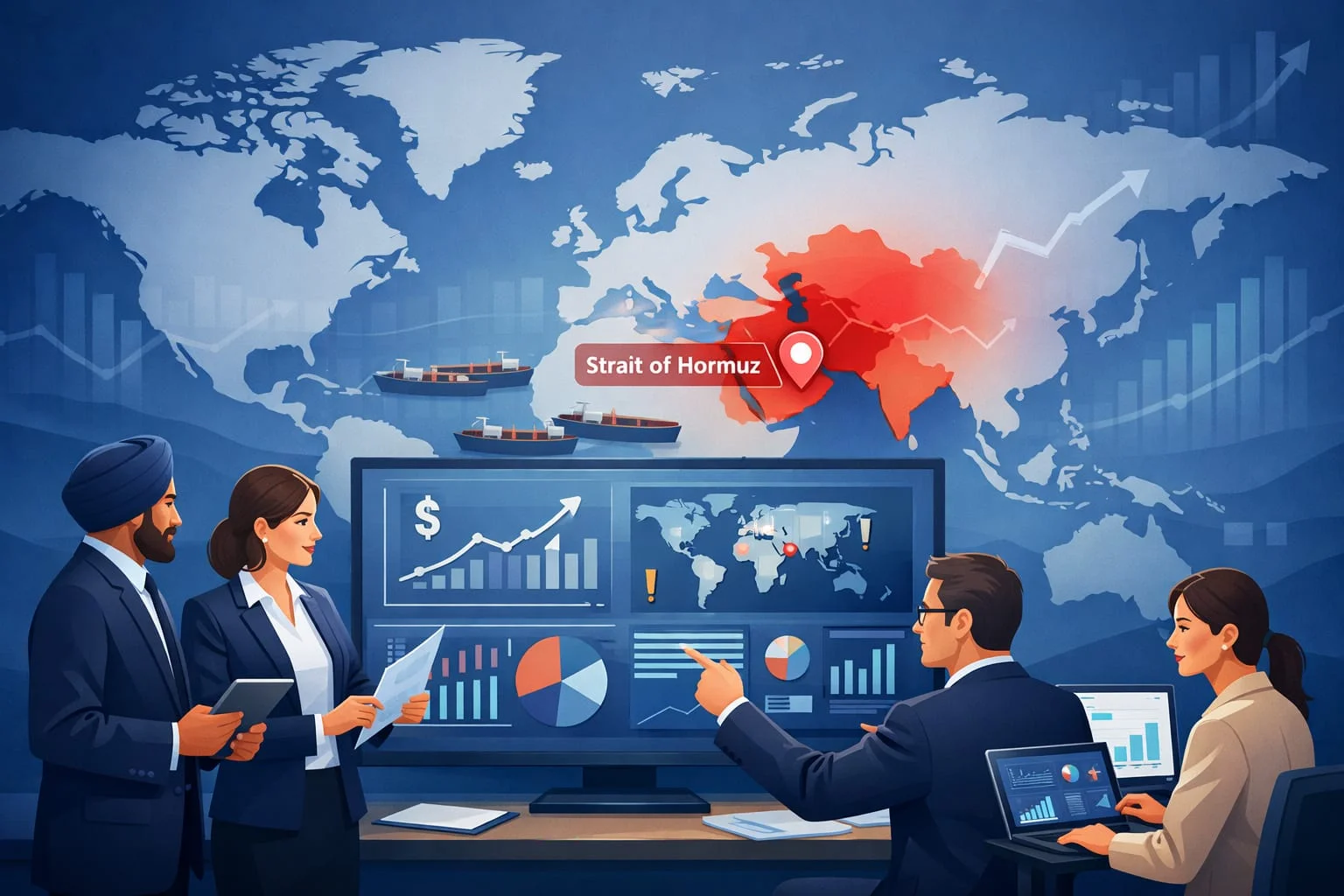
The Strait of Hormuz connects the Persian Gulf to the Arabian Sea. Approximately one-fifth of the world’s daily oil supply passes through this 33-kilometre waterway. Following military strikes on Iran in late February 2026, tanker traffic through the strait dropped by 70 per cent within 24 hours. Within days, ships had stopped broadcasting their positions entirely. The scale of the current disruption is historically significant. Cornell University economist Nicholas Mulder has described it as the largest oil supply shock in recorded history, estimating that the volume of lost supply could be three to four times greater than the combined shocks of the 1973 Oil Crisis and the 1979 Oil Crisis.
Those earlier crises triggered global recessions, accelerated inflation, and forced governments to rethink their long-term energy strategies for decades. If these estimates prove accurate, the current disruption would represent a shock of even greater magnitude, unfolding at a time when geopolitical tensions are already high and many developing economies have far less fiscal room to absorb another major energy crisis.
The Price Shock in Numbers
Before the conflict intensified, Brent crude was trading at roughly 70 dollars per barrel. Within a week, prices surged past 110 dollars, and by 9 March they briefly touched 119.50 dollars the highest level since 2022. Although the market has since cooled slightly, oil is still trading near 92 dollars per barrel, which remains about 27 percent higher than pre-crisis levels.
Energy analysts have been unusually blunt in their outlook. One analyst quoted on CNBC
summarized the situation with a stark warning: “The sky is the limit.” That statement reflects not speculation, but a clear signal of how volatile the market has become.
For companies planning expansion, managing procurement budgets, or designing logistics
strategies under the assumption of stable energy costs, these price movements make it
necessary to revisit and adjust those assumptions immediately.
What This Means for Supply Chains
The operational consequences extend far beyond rising fuel prices and are likely to intensify as the crisis continues to unfold. Several major shipping companies, including Maersk and CMA CGM, have already suspended operations in the Gulf region. Since 1 March, vessels travelling through or near the strait have reported multiple security incidents. In response, insurers have either withdrawn coverage for Gulf routes or increased premiums to levels that make voyages commercially unviable for most operators.
At the same time, key Gulf export facilities have faced security threats and operational
disruptions, prompting some producers to temporarily reduce exports and declare force majeure on selected contracts. These developments are not peripheral supply chain issues; they are disruptions occurring directly at the point of origin.
The Gulf region is a major source of crude oil, liquefied natural gas, petrochemicals, and
essential industrial raw materials. Companies that interpret the situation purely as a shipping challenge rather than a broader procurement and strategic risk may be significantly underestimating their exposure. As a result, delays and supply constraints are already beginning to ripple through manufacturing, retail, and global logistics networks.
The Inflation Transmission
Rising oil prices rarely remain confined to the energy sector. Instead, they ripple across nearly every cost component within a business. As oil prices climb, transportation expenses increase, raw material costs rise, and electricity generation becomes more expensive. Energy is embedded in packaging, logistics, and distribution as well, meaning these costs are also repriced when oil markets move upward. Companies that fail to model how these increases transmit through their entire cost structure risk finding their margin assumptions outdated very quickly.
For businesses operating in India, the exposure is particularly direct. The country imports
roughly 85 to 90 per cent of its crude oil, with a substantial share sourced from Gulf producers currently affected by the disruption. One widely cited estimate suggests that every 10-dollar increase in Brent crude adds more than 10 billion dollars to India’s annual import bill. At current price levels, this could translate into an additional 50 billion dollars or more in yearly import expenditure.
Such increases place pressure on the Indian rupee and contribute to rising inflation.
Policymakers then face a difficult trade-off: absorb the shock through fuel subsidies, which strain public finances, or allow higher prices to pass through to consumers, which weakens household purchasing power. Either scenario creates a more challenging environment for companies planning growth in the Indian market.
Capital Allocation Must Reflect Energy Risk
The deeper strategic issue is capital allocation. Businesses that have not factored energy price volatility into their expansion plans are working with incomplete financial assumptions. Operating a logistics network, manufacturing facility, or distribution system at 92 dollars per barrel is fundamentally different from doing so at 70.
Ignoring this shift can quickly make revenue projections and margin expectations unrealistic. In this environment, companies need to stress test cost structures, reassess supply chain dependencies, and model working capital needs under prolonged higher input costs. Investments in energy intensive operations should also face stricter return thresholds. Organizations that adapt their financial models now will be better positioned than those waiting for oil prices to return to pre-crisis levels.
Supply Chain Diversification Is Now Urgent
For years, supply chain diversification has been described as a strategic best practice. The events of 2026 have made it an operational necessity. Businesses that depend on a single geographic corridor for critical inputs, whether that is energy, raw materials, or manufactured components, are exposed to exactly this kind of concentrated risk. The Strait of Hormuz crisis has made that exposure visible and financially painful.
The strategic response requires action on several fronts. Alternative sourcing arrangements for energy-intensive inputs should be identified and contracted before the next disruption, not during it. Logistics planning should include route alternatives and contingency carriers. Inventory buffers for critical inputs may need to be rebuilt, accepting the working capital cost as a form of supply chain insurance.
Businesses entering new markets in this environment must also integrate energy cost sensitivity into their market-entry assumptions. Phased entry, strategic partnerships, and asset-light models reduce capital exposure in conditions where cost predictability is limited.
The Long-Term Structural Shift
The 2026 Hormuz crisis is accelerating a structural shift in how governments and businesses think about energy. Several major economies are fast-tracking plans to reduce dependence on Middle Eastern oil. Investment in renewable energy, domestic energy production, and energy storage is gaining urgency that no policy document could have created on its own.
The financial pain of the current disruption is making the long-term case for energy transition concrete and immediate. For businesses, this creates both a cost imperative and a strategic opportunity. Investments in energy efficiency, electrification of logistics and transportation, and renewable sourcing were already gaining traction. They are now gaining urgency. Companies that have deferred these investments are facing a sharper financial case for acting.
Operational efficiency in this context becomes a capital strategy, not just a cost optimisation exercise. Every unit of energy saved internally reduces exposure to external price shocks. Every improvement in logistics efficiency reduces the cost amplification that comes with higher fuel prices. These are not marginal gains. They are structural reinforcements.
Strategy in an Energy Conscious Era
The Middle East oil crisis of 2026 has introduced a new variable into every expansion
conversation: energy security. For businesses that had grown comfortable assuming stable and accessible energy, that comfort is no longer warranted. Capital must now carry the weight of energy risk. Expansion decisions must reflect supply chain exposure. Operational planning must account for a cost environment that may remain elevated for longer than current forecasts suggest.
The shift underway is not cyclical noise. It is a recalibration of how geopolitical risk, energy
access, and business strategy intersect. Companies that embed this recalibration into their
planning frameworks now will navigate the environment more effectively than those who treat it as a temporary shock to be waited out.
Sustainable growth in 2026 requires financial clarity, disciplined capital allocation, and supply chain resilience. Energy strategy is no longer a specialist function. It is a boardroom
conversation.