

Your cooking gas, your kitchen, your questions answered clearly.
If you’ve noticed your LPG cylinder taking longer to arrive, or spotted the price quietly creeping up on your bill, you’re not imagining things. Something real is happening, and Millions of households across India are feeling it right now. But before the word ‘crisis’ triggers panic, it’s worth pausing to understand what’s actually going on, why it started, what the government is doing about it, and most importantly, whether your kitchen is really at risk.
The short answer: this is a serious global disruption, not a collapse. India is responding. Here’s the full picture.
Where Did This Start?
Most of India’s cooking gas doesn’t come from under Indian soil. Around 60% of India’s LPG requirement is imported, and the bulk of those travels by sea through a narrow waterway in the Persian Gulf called the Strait of Hormuz.
In early March 2026, military escalation in the West Asia region effectively disrupted commercial shipping through the Strait. For context, this passage handles roughly 20% of the world’s oil, gas, and LPG trade every single day. When traffic through it slows down, the impact doesn’t stay in the Middle East; it travels directly to kitchen shelves across Asia.
India’s import dependence is the key reason the shock arrived so quickly. Of all the LPG India imports, approximately 90% of its imports normally pass through the Hormuz corridor. When that route got disrupted, the supply chain felt it almost immediately.
What Changed at Home
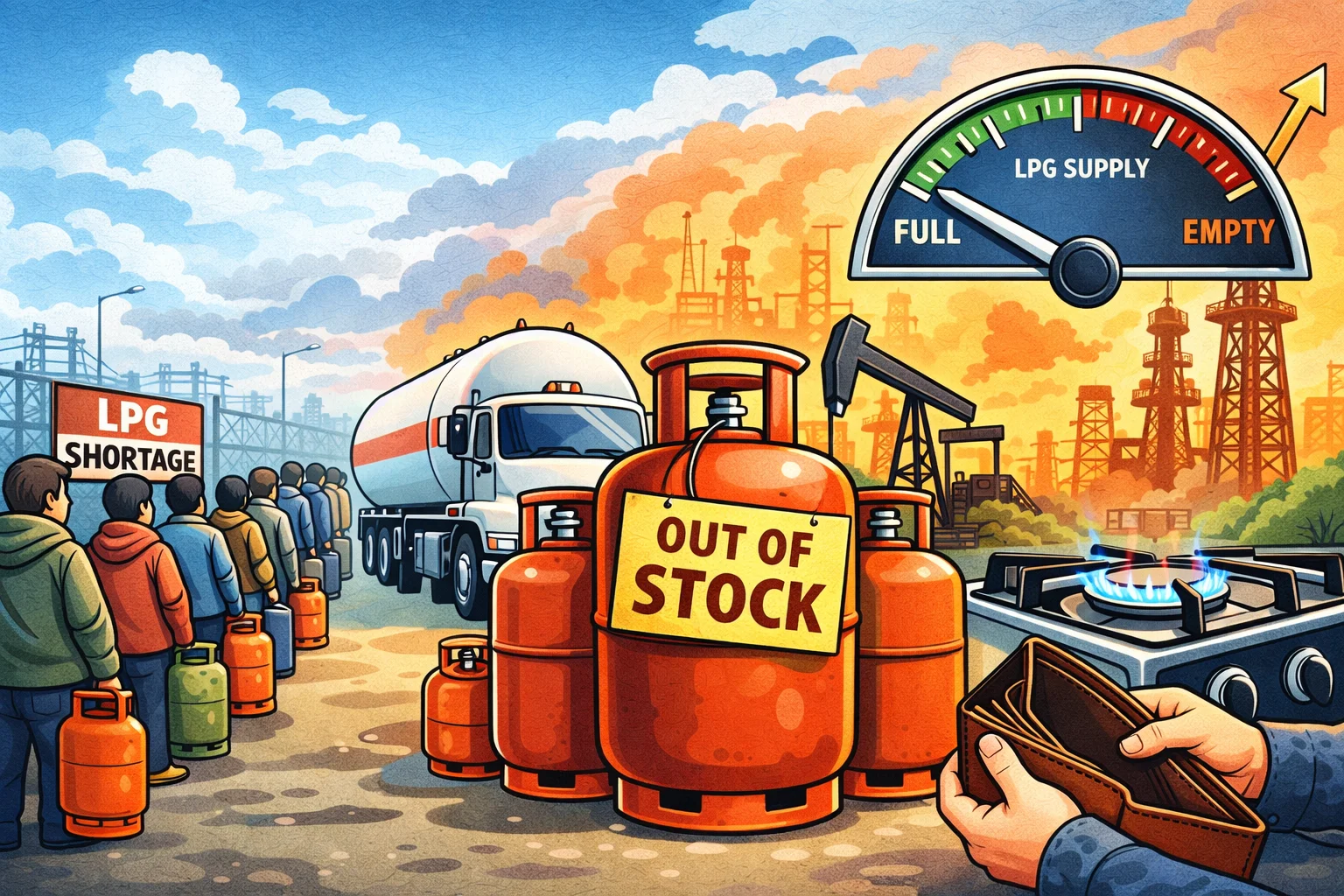
The effects appeared in two ways for most people: prices increased, and cylinders took longer to arrive.
On 7 March 2026, oil marketing companies raised the price of a 14.2 kg domestic cylinder by ₹60, bringing it to ₹913 in Delhi for non-subsidised consumers. For households covered under the PM Ujjwala Yojana, the effective price after the ₹300 government subsidy remains around ₹613.
Delivery timelines stretched in many cities. Urban areas that normally see refills within 25 days started reporting longer waits. In some cities, Chennai, Bengaluru, Kolkata, and Mumbai, queues formed outside LPG agencies, and reports emerged of commercial cylinders being harder to find or sold at inflated prices. The commercial sector felt it first and hardest. Restaurants, hotels, bakeries, and food stalls depend on LPG daily. With supplies prioritised for households, commercial users began facing tighter allocations. Some eateries in Andhra Pradesh reported cylinder availability dropping by 40 to 50%.
Households are protected first. When supply tightens, the government’s policy is clear: domestic cooking gas takes priority over commercial use.
The Numbers Behind the Shortage
To understand why this hit hard, consider these two figures side by side. India’s domestic LPG production in January 2026 stood at 1.158 million tonnes per month. Imports in the same period reached 2.192 million tonnes, nearly double the domestic output.
That import dependence isn’t a problem in normal times. It becomes one when the import route gets disrupted. India’s strategic LPG storage capacity, even after a new underground facility was commissioned in late 2025, covers roughly 5 days of national demand. Compare that to 60 days of strategic crude oil reserves, and you get a sense of how thin the LPG buffer was when the shock arrived. India consumes around 31.3 million tonnes of LPG annually across 33 crore households. That’s not a number you can easily replace overnight.
What the Government Did Fast
The response came quickly. Within days of the disruption, the government activated emergency measures under the Essential Commodities Act.
Refineries across India were directed to divert propane and butane streams normally sent to petrochemical plants entirely into LPG production for domestic use. The result: a 25 to 28% surge in domestic LPG output within two weeks.
On 12 March 2026, the Union Petroleum Minister announced in Parliament that Commercial LPG supply would be capped at 20% of average monthly volumes, essentially cutting commercial allocation by 80% to prevent hoarding and ensure households remained protected.
A priority sequence was issued under the Natural Gas Control Order: household cooking gas, CNG for vehicles, and hospitals receive a full supply with no cuts. Refineries and power plants receive 80% of their previous six-month average. Petrochemical and fertiliser plants receive 70%. The government also approved a ₹30,000 crore compensation package for oil marketing companies and a separate ₹17,500 crore OMC support package to absorb a larger portion of the underlying cost increase and shield households from the full market-level price.
The Delivery Authentication Code (DAC) system, a one-time verification code sent to your phone before a cylinder is logged as delivered, has been expanded from 50% to 90% of consumers to prevent diversion.
India Is Already Finding New Routes
The government didn’t stop at emergency measures. It moved quickly to diversify where India’s LPG comes from.
An early 2026 agreement with the United States for 2.2 million tonnes of LPG per year, equivalent to about 10% of India’s annual imports, was already in place before the crisis deepened. Active talks are underway with Algeria, Australia, Canada, and Norway for shipments that bypass the Persian Gulf entirely.
Simultaneously, about 70% of India’s crude oil imports have been rerouted through alternative shipping paths, compared to 55% before the current tensions. The diversification isn’t complete, but it is real and moving.
What This Means for Your Kitchen Practically
For most households with a domestic connection under Indane, HP Gas, or Bharat Gas, the situation is managed. Delivery time from booking to receipt remains at approximately 2.5 days from pre-crisis norms in most urban areas. Hospitals and educational institutions are on uninterrupted priority supply.
If you’re experiencing delays, the most practical steps are: book early rather than waiting until your cylinder runs out, pay only the official price and insist on a receipt, and avoid informal channels that charge premiums; these worsen local shortages for everyone. If you have access to piped natural gas (PNG) infrastructure, it is on full supply with no cuts and is a reliable alternative during this period. Induction cooktops are also seeing increased interest as a backup cooking option. For restaurant and food business owners, the situation is tighter. Commercial cylinders are under allocation caps, and costs have risen. The advice from supply chain experts is straightforward: plan around smaller, more frequent orders rather than bulk bookings. and explore whether PNG connectivity is available in your area.
The Bigger Question This Crisis Is Asking
What’s unfolding is more than a supply hiccup. It’s a clear signal about how dependent India’s daily life is on a single maritime corridor thousands of kilometres away. The gap between 5 days of LPG strategic reserves and 60 days of crude oil reserves tells a story that policymakers will need to address, not because of panic, but because infrastructure built for stable times needs to be resilient for disrupted ones.
Analysts point to the need for expanded strategic LPG storage, faster terminal capacity at non-Gulf sourcing locations, stronger pipeline connectivity within India, and broader consumer adoption of PNG and clean electric cooking alternatives.
The diversification already underway, US LPG deals, Australian and Canadian sourcing talks, alternative shipping routes show the direction is right. The question is how quickly it can scale.
Every supply shock like this one accelerates the longer conversation about energy resilience. That’s not a bad outcome if it leads to lasting infrastructure improvements.
Crisis or Disruption? Here’s the Honest Answer
A crisis implies a breakdown. A disruption implies something working hard to recover. What India is experiencing in March 2026 is the latter.
The root cause of a global shipping disruption through a critical energy route is real and external. The supply pressure on households is real, though actively managed. The price increase is real, though partially absorbed by government support. The long queues and delays in some cities are real, though easing as domestic production ramps up.
What isn’t real is the idea that this is unmanageable or irreversible. The government has moved fast with legal orders, production rerouting, alternative sourcing, and consumer protections. The supply chain is under stress, not broken.
For now: book your cylinder on time, use gas efficiently, stay calm about the wait, and trust that the kitchen will keep running. India has navigated energy shocks before, and it is navigating this one too.