

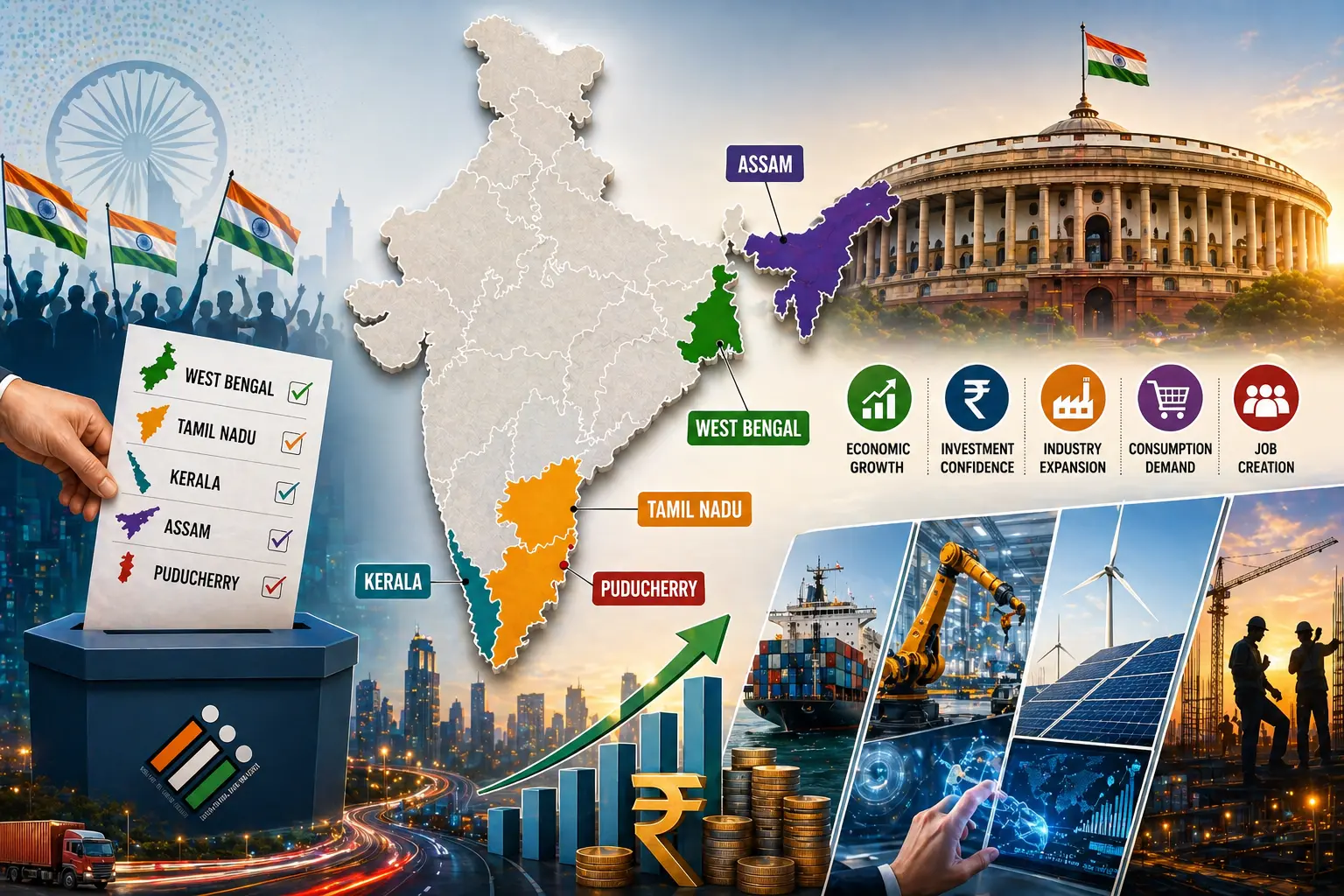
Five states and one union territory. Eight hundred and twenty-four assembly seats. Millions of voters are making decisions that will shape five distinct economies for the next five years. The counting is done, the results are in. Here is what they mean for investment, business, jobs, and growth across some of India’s most economically significant regions.
Every five years, state assembly elections do something that national economic forecasts often miss. They decide who controls the levers of industrial policy, infrastructure spending, land acquisition, labour law administration, power pricing, and investor relations in some of India’s largest and most strategically important states. The results announced on 4 May 2026 for West Bengal, Tamil Nadu, Kerala, Assam, and Puducherry are not just a political scorecard. They are an economic map of what the next five years could look like across a combined population of over 300 million people. Together, these five regions represent a significant share of India’s industrial output, IT exports, tea production, automobile manufacturing, tourism revenue, and coastal trade. Understanding what election outcomes mean for these economies is not a matter of political opinion. It is a matter of business planning, investment strategy, and informed decision-making for anyone with interests in these markets. This article does not take political sides. It examines each state and union territory through the lens of economy and opportunity, drawing on verified data to explain what is at stake for businesses, investors, and residents in each region.
Five states and one union territory, with a combined economic output worth trillions of rupees. The results of these elections will shape infrastructure spending, investment policy, and business conditions across a third of India’s population for the next five years.
Why State Elections Matter for the Economy
The connection between state election outcomes and economic performance is direct and well-documented. State governments control several of the most important variables in any investment or business decision. They administer land acquisition processes. They set electricity tariffs for industry. They determine the speed and efficiency of regulatory approvals. They decide how aggressively to pursue global investment summits, industrial corridors, and special economic zones. And they manage the day-to-day functioning of law and order, which directly affects factory operations, supply chains, and labour relations.
A state with a stable, business-friendly government that actively competes for investment can attract manufacturing plants, technology campuses, and logistics hubs that take years to build but generate employment and tax revenue for decades. A state that creates uncertainty, moves slowly on approvals, or has difficult land acquisition processes will simply watch those investments go to competing states instead. In this respect, India’s states are genuinely competing with each other for the same pool of domestic and foreign capital.
The five regions that just voted span the full spectrum of India’s economic character. Tamil Nadu is a manufacturing and IT powerhouse. Kerala is a service, tourism, and remittance economy with a high human development index. West Bengal is a large, diverse economy punching below its potential. Assam is a growing northeastern gateway with enormous natural resources. Puducherry is a small but strategically placed union territory with a growing hospitality and pharmaceutical sector. Each tells a different story.
Tamil Nadu: India’s Manufacturing and Export Engine
Tamil Nadu is not just a large state. It is India’s second-largest economy by state GDP, contributing 9.4% of the national GDP despite having only 4% of the country’s land area and 6% of its population. That outsized contribution reflects decades of investment in manufacturing infrastructure, a skilled workforce, strong port connectivity, and a long standing tradition of industrial policy that treats investors seriously.
The state’s economic credentials going into this election were remarkable. Tamil Nadu recorded real GDP growth of 11.2% in 2024–2025, the highest among major Indian states and the first double-digit growth in fourteen years. Manufacturing, which contributes 33% of state GDP, expanded by 14.74% in that same year, more than three times the national average. Merchandise exports from the state reached $52.07 billion in FY25, with Tamil Nadu ranking first in India for electronics, textiles, and leather exports.
The key business story to watch in Tamil Nadu over the next five years is whether the state can sustain and deepen the investment momentum it has built. In late 2025, the state government secured a major commitment from Rolls-Royce to establish a Maintenance, Repair, and Overhaul facility in Hosur, alongside a research centre. Hyundai signed a landmark agreement for shipyard expansion and electric vehicle manufacturing. The government approved port infrastructure projects worth over ₹93,000 crores. The direction is clear: Tamil Nadu is positioning itself as India’s hub for advanced manufacturing, aerospace, defence, and clean mobility.
For businesses and investors watching Tamil Nadu, the state’s ambition to become a one-trillion-dollar economy by 2030 is not rhetorical. It is backed by a fiscal deficit of just 3% of GSDP, a declining debt-to-GSDP ratio, and a government that has consistently increased capital expenditure on roads, ports, and industrial corridors. Stability of economic policy direction in Tamil Nadu is, therefore, among the most significant business outcomes of this election season.
Tamil Nadu contributed 9.4% of India’s national GDP while occupying just 4% of its land. With manufacturing growing at three times the national average and exports crossing $52 billion, this state is not just growing, it is leading the industrial story of modern India.
West Bengal: The Gateway Economy with Untapped Potential
West Bengal is India’s sixth-largest state economy by size, with a projected Gross State Domestic Product of $236.56 billion in 2025–2026. It is also one of the most underappreciated investment destinations in India, a state that combines strategic geography, natural resources, and a large consumer base with a track record that has not always matched its potential.
The state’s strengths are genuine and significant. West Bengal is India’s largest rice producer. It is the second-largest tea-growing state, accounting for 25.15% of national tea production and home to the globally celebrated Darjeeling variety. The state is India’s gateway to the northeast, Bangladesh, Bhutan, and Southeast Asian trade routes through the Land Port at Petrapole, which is among the busiest land ports on the subcontinent. Haldia Port handles substantial petrochemical and bulk cargo traffic. Kolkata remains one of India’s most important financial and commercial centres. Recent investment signals have been encouraging. In July 2025, the West Bengal government announced that the state had attracted ₹1,33,000 crores in private investment and generated 1.8 lakh jobs across steel, energy, oil and gas, and logistics sectors. The industrial sector grew at 7.3% in 2024–2025, exceeding the national average of 6.2%. Haldia Petrochemicals are exploring an investment of approximately ₹8,500 crores in a new polycarbonate production plant. The Bengal Silicon Valley Tech Hub, designed to create 1,00,000 direct jobs in IT and technology, is an infrastructure project of genuine ambition. For West Bengal, the central economic question is whether the next five years will see a measurable improvement in ease-of-doing-business indicators, faster clearance of industrial projects, and a sustained effort to bring the state’s investment climate in line with its enormous structural advantages. The state ranked eleventh among Indian states on ease of doing business according to a World Bank and KPMG study, which reflects both progress made and further progress possible. Political stability and consistent policy will be the deciding factor in whether investors choose Bengal over competing states in the years ahead.
Kerala: The High Human Development Economy Built on Services and
Remittances
Kerala operates on a fundamentally different economic model from most Indian states. It does not have the large-scale manufacturing base of Tamil Nadu or Gujarat. It has the highest literacy rate in India, the most extensive healthcare infrastructure per capita, a well-travelled and globally connected workforce, and a remittance economy that generates billions of dollars in foreign exchange every year from the millions of Keralites working across the Gulf, Europe, and North America.
This model has produced some genuinely impressive outcomes. Kerala’s per capita income is among the highest of any major Indian state. The state’s Human Development Index scores consistently exceed the national average by a significant margin. Its IT exports are approaching ₹1,00,000 crores annually, with Kochi emerging as a credible technology destination connected by submarine cables and satellite gateways to major global cities. The fisheries sector, supported by central funding of ₹1,346 crores for modern fishing harbours and coastal infrastructure, is a significant export earner and employer. Tourism, built on the global brand of “God’s Own Country,” consistently attracts high-spending domestic and international visitors.
The economic challenge for Kerala in the next five years is twofold. First, the state’s fiscal position requires careful management. Kerala has run significant deficits over recent years, and the central government has at times restricted the state’s borrowing limits, creating friction in infrastructure financing. Second, the state needs to convert its exceptional human capital into deeper economic diversification, capturing a larger share of the global technology, healthcare, and professional services economy that its educated population is well-suited to serve. For businesses looking at Kerala, the state’s strengths in education, healthcare, technology, tourism, and marine products are durable competitive advantages. The 48 new seaplane routes approved under the UDAN scheme in 2025 reflect the government’s intent to deepen tourism connectivity. The Kochi Metro expansion, the Vizhinjam deep-water international port, and the growth of Kochi as a smart city, all represent infrastructure investments with long-term economic payoffs.
Kerala’s IT exports are approaching one lakh crore rupees annually. Its fisheries
sector is being modernised with central funding. Its deep-water port at Vizhinjam is close to completion. This is an economy quietly building for the next decade, not just managing the present one.
Assam: The Northeast’s Rising Economic Frontier
Assam holds a unique position in India’s economic geography. It is the gateway to the entire northeast region, sharing borders with seven other states and international boundaries with Bangladesh, Bhutan, and Myanmar. That geography alone makes it strategically important for India’s Act East Policy and its ambition to develop trade routes into Southeast Asia. The state is built on three foundational economic pillars. Tea is the most globally recognised: Assam accounts for 48% of India’s total tea exports by value, and tea production in the state stood at 497.33 million kilograms in 2025.
Petroleum is the second: Assam is India’s third-largest producer of petroleum and natural gas, with established refineries at Digboi, Guwahati, Bongaigaon, and Numaligarh contributing to both national energy supply and state revenues. Biodiversity and tourism form the third pillar: Kaziranga National Park recorded over 4,43,636 visitors in the 2024–2025 season, a 35% increase, making it the third most-visited national park in India. The infrastructure investment announcements ahead of this election were transformational in scale. The central government announced plans to invest ₹3,00,000 crores in upgrading Assam’s national highways, including a Guwahati Ring Road and a tunnel under the Brahmaputra River at Dibrugarh. Two new rail links connecting Assam and West Bengal to Bhutan were announced in September 2025. The Advantage Assam 2.0 Summit in February 2025 generated investment commitments of over ₹8,000 crores for tourism infrastructure, including luxury river cruises, wildlife lodges, and ecotourism circuits.
For businesses watching Assam, the economic story is one of a state on the cusp of a significant transition. Infrastructure at this scale, once built, permanently lowers the cost of doing business, improves supply chain connectivity, and opens access to new markets across the northeast and beyond. The establishment of the 22nd Indian Institute of Management in Guwahati signals a long-term commitment to building institutional capacity alongside physical infrastructure. Assam in 2031 could look very different from Assam today, and the next five years of state government will determine how much of that potential is realised.
Puducherry: The Small Union Territory with a Distinctive Economic Niche
Puducherry is small in area but distinctive in character. The union territory combines a French colonial heritage that gives it a unique tourism identity, a growing pharmaceutical manufacturing base, a thriving education sector, and coastal geography that supports fisheries and seafood exports. Its per capita income is among the highest in India for any union territory, reflecting a relatively prosperous and urbanised population.
The economic significance of Puducherry’s election results lies primarily in two areas. First, the stability of its tax and regulatory environment relative to its larger neighbour Tamil Nadu creates niches for specific industries seeking favourable operating conditions. Second, its tourism economy, built around the Auroville international community, French-quarter heritage streets, beaches, and wellness retreats, requires consistent governance and infrastructure investment to grow. For investors in hospitality, real estate, and lifestyle sectors, Puducherry’s policy direction matters considerably.
The Bigger Picture: What These Results Mean for India’s Economy as a Whole
Viewed together, these five election outcomes send several important signals to the national and global business community. First, they confirm that India’s economic diversity at the state level is a strength, not a complication. No single model dominates. Tamil Nadu leads in manufacturing and exports. Kerala leads in human development and services. West Bengal leads in agricultural output and geographic connectivity. Assam leads in natural resources and tourism potential. Puducherry carves its own niche in heritage and pharmaceuticals. This diversity means that a slowdown or shock in one sector or region does not necessarily drag the others down with it. Second, all five states are engaged in active competition for investment. The days of states passively waiting for central allocations are long over. Every major state now runs global investor summits, maintains dedicated investment promotion agencies, offers sector-specific incentive packages, and actively lobbies for central infrastructure projects. That competition is healthy for the overall investment climate, because it puts pressure on every state government to improve its ease-of-doing-business rankings, clear project approvals faster, and deliver on the promises made to investors. Third, state elections in 2026 matter because they set the tone ahead of the 2029 Lok Sabha elections. States with growing economies, rising employment, and improving living standards will have powerful arguments to make. The economic performance of each state government over the next three years will be both a policy story and a political one, creating a strong incentive for delivery over announcement.
These five states together represent a combined economic output of roughly 30
35 percent of India’s national GDP. The decisions made in their new legislatures
will shape infrastructure, investment, jobs, and living standards for hundreds of
millions of people. Elections end on counting day. Governance begins the morning after.
What to Watch in the Months Ahead
For businesses and investors, the immediate post-election period in each state will reveal a great deal about policy direction. Watch for three things in each state: the speed and composition of cabinet formation, which signals what sectors the new government prioritises; the first state budget, which reveals fiscal discipline and spending priorities; and the handling of any pending large investment proposals, which tests whether election-period commitments translate into actual approvals. In Tamil Nadu, the focus will be on whether the current trajectory of advanced manufacturing investment continues and deepens. In West Bengal, the question is whether investor confidence improves meaningfully. In Kerala, the test is fiscal management alongside continued IT and tourism growth. In Assam, the infrastructure pipeline is large enough that execution quality will matter more than further announcements. In Puducherry, stability and consistency of governance are the primary economic requirements.
India’s growth story in 2026 and beyond is not only a central government story. It is a story of thirty-plus states and union territories making daily decisions about land, power, logistics, education, and business environment. The five results announced on 4 May 2026 are five new chapters in that story. The quality of what gets written in the next five years will determine whether each state’s economic potential is realised or once again deferred. India is a country where state-level governance quality can make an enormous difference to economic outcomes. The voters of West Bengal, Tamil Nadu, Kerala, Assam and Puducherry have made their choices. The responsibility now shifts to the governments they have elected.