


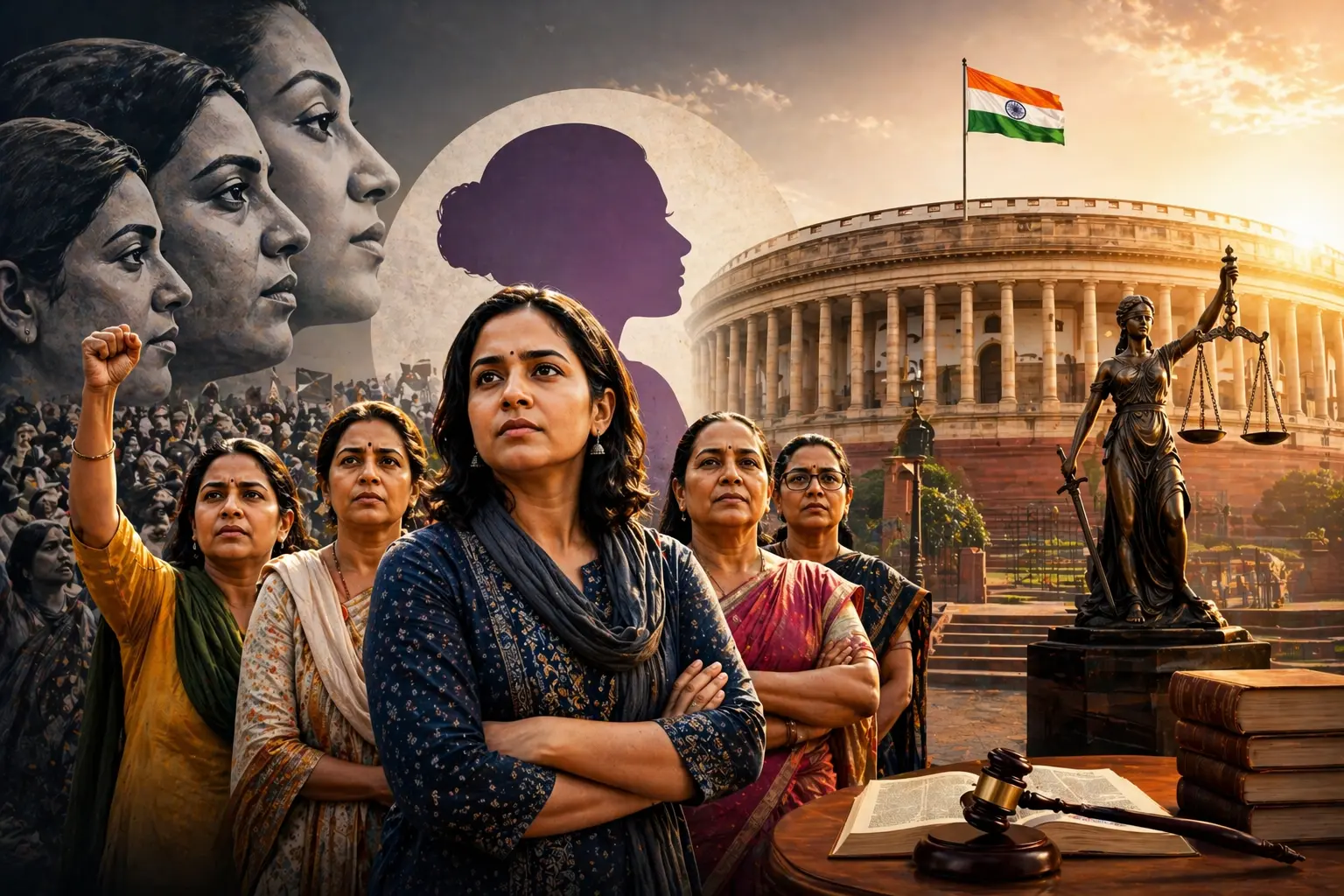
A law was passed. A bill was introduced to activate it. That bill was then rejected. And just like that, one of India’s most debated reforms, 33% seats for women in Parliament, slipped further into uncertainty. Here is the complete story of why this has taken 30 years, what exactly happened in Parliament this week, and what it means for Indian women.
On 17 April 2026, something unusual happened in the Lok Sabha. The government introduced a bill that was, at its heart, supposed to help women. It was designed to finally bring into effect a law that was already passed three years ago, one that promised one-third of all parliamentary seats to women. The bill was debated by 130 MPs, including 56 women. And then it was voted down.
With 298 votes in favour and 230 against, the government fell 54 votes short of the two-thirds majority required for a constitutional amendment. The bill failed. The Lok Sabha was adjourned. Two related bills were withdrawn. And India’s women were left, once again, watching a promise drift further into the future. For the people watching the live parliamentary feed, the scene was familiar. Not because it was unremarkable, but because India has been here before. Many times. Over thirty years.
India has 14% women in Parliament. The global average is nearly 27%. Our neighbour Nepal has 33%. Rwanda has 61%. And yet, in 2026, the legislation meant to address this gap has been rejected, delayed, or tied in procedural knots since 1996.
The Numbers That Tell the Real Story
Before getting into the politics, it helps to understand just how large the representation gap really is. The data is striking.
When the first Lok Sabha was elected in 1952, women made up just 4.4% of its members. Over seventy years later, that number stands at approximately 13.6%, rising from 5.4% in 1957 to a peak of 14.4% in the 2019 elections. Progress has happened, but it has been painfully slow for a democracy of this scale.
The contrast with voting behaviour is what makes this particularly striking. Indian women now vote in roughly equal numbers to men, and turnout among women reached 67.2% in 2019, slightly higher than the male turnout. Women are enthusiastic, engaged voters. They simply do not see themselves reflected in the halls where laws are made.
| Country | Women in Parliament | Status |
|---|---|---|
| Rwanda | 61% | World leader |
| Sweden | 46% | Nordic benchmark |
| Nepal | 33% | Implemented quota |
| Bangladesh | 21% | Has reserved seats |
| Global Average | ~27% | IPU 2026 data |
| India | 13.6% | 30-year debate, no implementation |
In the Inter-Parliamentary Union’s global rankings, India sits around 149th out of 193 nations on women’s representation in the lower house of parliament.
A country that routinely leads global conversations on democracy and development ranks near the bottom on this specific measure.
Thirty Years in a Timeline: How We Got Here
This is not a new debate. The Women’s Reservation Bill has been introduced, debated, disrupted, passed in one house, blocked in another, and finally signed into law, only to now be stuck again at the implementation stage. Here is the full journey.
| Year | What Happened |
|---|---|
| 1996 | Women’s Reservation Bill was first introduced in the Lok Sabha, lapsed without being passed. |
| 1998–2002 2008 | Bill was reintroduced in three successive sessions, blocked each time, often by physical disruptions in Parliament. Introduced again by the UPA government under PM Manmohan Singh. |
| 2010 2014–2023 Sept 2023 Apr 2026 | Rajya Sabha (Upper House) passes the bill with a large majority. Lok Sabha never takes it up. Bill lapses. Bill not introduced. Women’s representation rises slightly but remains below 15%. Nari Shakti Vandan Adhiniyam passed by both Houses with an overwhelming majority, but implementation is tied to the census and delimitation. Delimitation Bill 2026 is needed to activate the 2023 law rejected in the Lok Sabha. Lok Sabha adjourned sine die. |
What makes the timeline particularly difficult to read is the recurring pattern: broad agreement in principle, sharp disagreement on conditions, and procedural mechanisms that delay actual implementation. The 2023 passage was celebrated as historic.
But it came with a condition that no one could control a census that had already been delayed by the pandemic, and a delimitation process that would add further years before the law could take effect.
The 2023 Women’s Reservation Act is a law that exists on paper but cannot be implemented without a census and delimitation. The census reference date is March 2027. The delimitation after that could take another 12-18 months. This means the earliest the reservation could realistically apply is the 2034 general elections.
What Exactly Happened in Parliament This Week
To understand this week’s events, it helps to understand what the government was actually trying to do. The 2026 bills did not introduce a new Women’s Reservation Bill. The government was trying to remove the conditions that were blocking the 2023 law from taking effect. Three bills were introduced in the Lok Sabha on 16 April 2026. The Constitution (131st Amendment) Bill 2026 proposed to remove the requirement that women’s reservation wait for a new census, instead of allowing delimitation to proceed based on the already available 2011 census data. It also proposed to expand the Lok Sabha from 543 to 850 seats, the largest expansion since the House was originally constituted.
The Delimitation Bill 2026 provided the mechanism for how that expansion and redrawing of constituencies would actually happen. Together, the government’s argument was: use the 2011 data, redraw the constituencies, and women’s reservation can begin by the 2029 general elections.
The opposition’s argument was different, and it came from two directions. The first was about the southern states. Because southern India has controlled its population more effectively than northern states over the past fifty years, any seat redistribution based on
population would likely reduce the number of Lok Sabha seats for Tamil Nadu, Kerala, Andhra Pradesh, Telangana, and Karnataka, while increasing seats for states like Uttar Pradesh, Bihar, Madhya Pradesh, and Rajasthan. Southern MPs across party lines called this deeply unfair. The second opposition argument was more direct: why was women’s reservation being tied to this controversial seat expansion at all? Multiple opposition leaders and women’s groups demanded that the reservation be implemented immediately, within the existing 543-seat Lok Sabha, without waiting for any delimitation whatsoever. If the government truly wanted to empower women, the argument went, it could do so right now, no new census, no expansion, no boundary redrawing required.
“The government is using women’s rights to sugar-coat a massive electoral overhaul that would unfairly shift political power toward certain states.” Opposition position as characterised in the debate
On 17 April 2026, the vote was held. Of the 528 members present, 298 voted in favour, and 230 voted against. A constitutional amendment requires two-thirds of those present and voting, which meant 352 votes were needed. The bill fell 54 votes short.
The government withdrew the two related bills. The Lok Sabha was adjourned sine die. This marked the first time a constitutional amendment brought by the current Union Government has failed on the floor of the Lok Sabha.
Why Has This Taken 30 Years? The Real Reasons
The answer is more complex than any single party or political moment. The delay in Women’s reservation has had different causes at different times, and understanding them honestly matters.
▶ The OBC sub-quota demand: For much of the 1998–2010 period, the primary obstacle was not opposition to women’s reservation itself, but demands from parties representing Other Backwards Classes that a sub-quota for OBC women be carved out of the 33%. The fear was that without it, reservations would primarily benefit upper-caste and urban women, leaving rural and lower-caste women underrepresented even within the quota. This remains a live debate today.
▶ The census and delimitation condition: Attached to the 2023 law, this condition was criticised from the moment it was announced. The 2021 census was delayed by COVID and has still not been completed. The next census is expected around 2027. The delimitation after that takes further time. Critics argued the condition was designed to postpone implementation indefinitely while giving the appearance of action.
▶ The southern states’ seat concern: This is a genuine constitutional tension. States that successfully reduced their population growth rates now face losing parliamentary representation if seats are redistributed purely by population. Tamil Nadu and Kerala, for instance, could lose a combined 16 seats under some projections. This is not a small concern; it is a federal fairness argument with real stakes.
▶ Political incentive misalignment: Across parties and decades, there has been a recurring pattern where male MPs who would need to give up their seats for women candidates have found reasons to delay. The reservation, once implemented, would rotate, meaning constituencies currently held by sitting MPs could become reserved for women. This creates a structural incentive to delay that cuts across party lines.
What Indian Women Have Achieved Despite the Delay
It is important not to let the parliamentary struggle define the entire picture of Indian women’s progress. The political representation gap exists against a backdrop of significant advances in other domains.
India has women leading major state governments. Women have served as the President of India, as Chief Ministers, as Supreme Court judges, as corporate CEOs, and as world class athletes. India’s self-help group movement involving over 90 million women across rural India is one of the largest grassroots economic empowerment programmes in the world. India already mandates one-third reservation for women in local governing bodies (panchayats and municipalities), and studies show this has meaningfully changed policy priorities at the local level. The argument for parliamentary reservation is not that Indian women are incapable without it. It is that the decisions made in Parliament about health, education, safety, labour, and economic policy affect women disproportionately and yet women have a disproportionately small voice in making those decisions. Representative democracy works better when it actually represents the population it governs.
Indian women vote at nearly equal rates to men. They serve in the military, lead businesses, run state governments, and bring home medals at the Olympics. The gap is not in capability. It is in the structure of access to the rooms where laws are made.
What Happens Next
With the Lok Sabha adjourned sine die and the Delimitation Bill withdrawn, the immediate legislative path is closed for now. The government will need to either rebuild a coalition with enough cross-party support to get past the two-thirds threshold or find a different approach entirely. The opposition has stated it will write to the Prime Minister demanding that women’s reservation be implemented as a standalone measure within the existing 543-seat house, without any delimitation linkage. This is also the position of most women’s rights organisations, which have been active on this issue for decades.
→Option 1: The government could reintroduce the bills in the next session with modifications that address the southern states’ concerns, such as a constitutional guarantee that no state will lose its current number of seats in the transition. This could potentially bring enough opposition MPs on board.
→ Option 2: The government could delink women’s reservation from the seat expansion entirely and pass a separate amendment implementing 33% reservation on the current 543 seats. This is what many opposition parties and civil society groups are demanding.
→ Option 3: The census is completed in 2027, delimitation follows, and the 2023 law eventually takes effect, but this timeline points toward the 2034 elections, not 2029.
What is clear is that the 2026 rejection does not end the conversation. It accelerates it.
Search interest in “Women’s Reservation” reached peak levels on Google Trends in India in April 2026, and public pressure on this issue has not diminished. If anything, this week’s events have brought more attention to a question that has waited long enough.
The Honest Summary:
introduced in 1996, is now in her early fifties. She has voted in eight general elections. She has paid taxes, raised a family, and built a career. And through all of it, the legislation that would meaningfully increase the number of women who look like her in Parliament has been introduced, blocked, passed, conditioned, and now rejected in its enabling form.
The debate has real complexity, the OBC sub-quota question is legitimate, the southern states’ seat concern is genuine, and the constitutional mechanics of delimitation are real constraints. These are not invented excuses. But the cumulative effect of thirty years of genuine complexity and political convenience working together is the same: 13.6% women in a Parliament that governs 1.4 billion people, nearly half of whom are women. What happens in the next Parliament session will matter greatly. Whether the government finds a new path, whether the opposition shifts from opposition to negotiation, and whether the public pressure generated by this week’s events translates into political will, these are the questions that will determine whether this story has a different ending, or whether we are reading a version of the same article again in 2029. India’s women deserve better than an answer of “eventually.” They have been patient for thirty years. Eventually, it should already be now.