


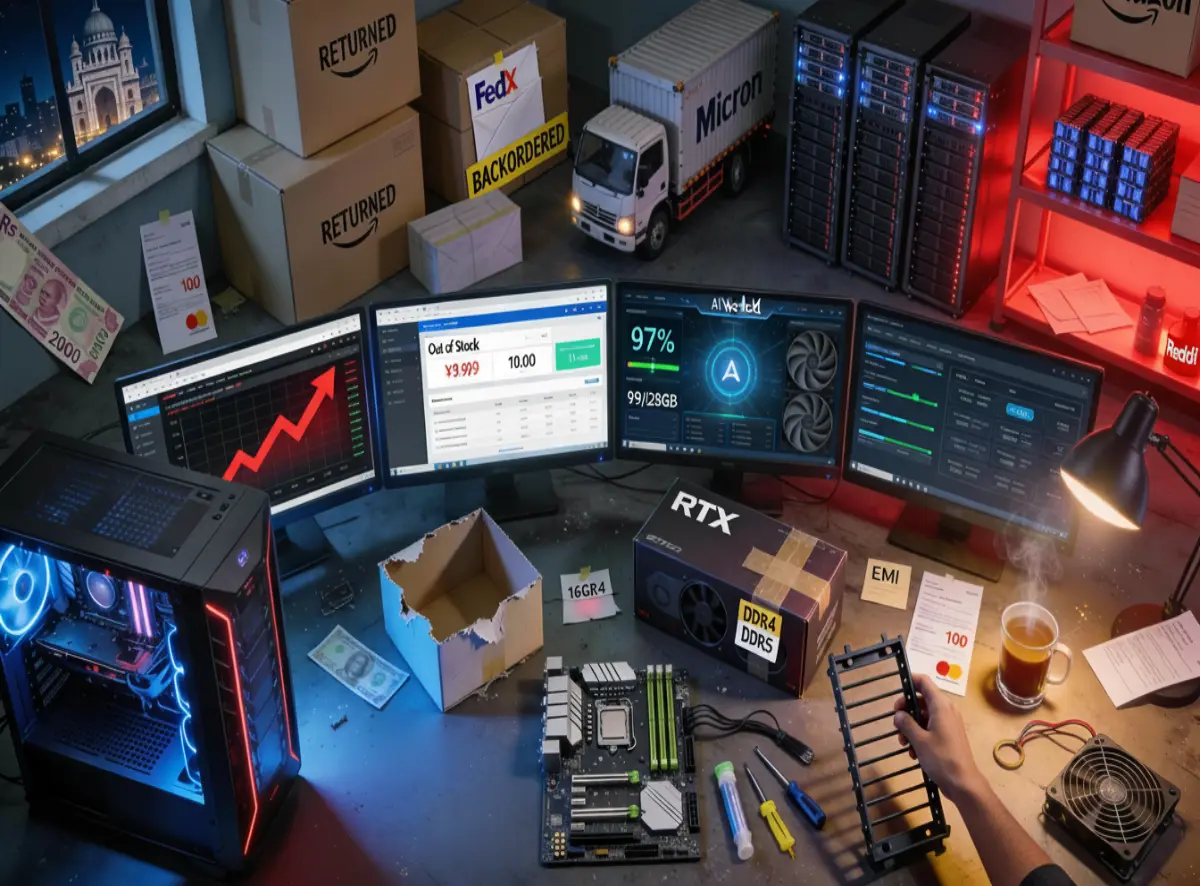
Analyzing how 2025’s AI surge spiked PC hardware costs across India and how smart buyers are adapting.
PC builders know the pain all too well this winter. DDR5 prices have jumped sharply in just a few months. Graphics cards cost significantly more than last Diwali. AI training workloads quietly sucked up global memory supply, turning ChatGPT hype into enterprise GPU farms that rewrote hardware economics.
The RAM crunch hits everywhere. Casual gamers grab 16GB kits at double 2024 prices. Professionals scramble for 64GB workstation builds. Even budget laptops ship with 8GB minimums that feel obsolete overnight. Small YouTube creators running 4K edits hit swap file warnings daily. Data scientists fine-tuning models on laptops watch hours vanish into thermal throttling.
Boom By Brutal Numbers
Component trackers paint a grim picture that keeps getting worse. DDR5‑32GB kits climbed steadily since October, while top-end RTX 50 series GPUs now command premium scalper prices. Enterprise-grade high-bandwidth memory has surged for AI data centers, leaving consumer shelves bare. Next-gen NVIDIA cards vanished within hours of launch.
Supply chains tell the full story. Major memory manufacturers have diverted a large share of high-end DRAM to server contracts. TSMC prioritized advanced packaging for enterprise GPUs over consumer silicon. Indian assemblers face extended lead times on premium builds, with local distributors rationing high-end RTX cards weekly.
Tier 2 cities bear the brunt. Custom PC shops in Lucknow and Coimbatore raised minimum quotes significantly. Students push upgrades to semester breaks. Small studios pivot to cloud rentals at Rs 50 per hour per GPU. Hyderabad gaming cafes even added “AI hourly” slots at premium rates.
AI Workloads Completely Changed The Rules
Two years ago, gamers drove DDR5 demand. Enterprises flipped that script by training models on consumer hardware. Large language model fine-tunes devour massive RAM for hours. Hyperscalers scoop up high-end RTX cards in bulk for 24/7 inference farms. AI image generation workloads demand substantial VRAM minimums.
AI hobbyists chase these popular setups:
- 64GB DDR5 with RTX 4090 around Rs 3.2 lakh for a complete build
- Threadripper workstation with 256GB ECC around Rs 8.5 lakh
- Mac Studio Ultra configurations around Rs 6.8 lakh that sell out monthly
These example builds and price points are indicative of what many Indian buyers are seeing in the market, not official MRP figures.
Budget compromises keep enthusiasts in the game. Ryzen 7 systems pair with 32GB for more reasonable totals. Chinese partner cards flood Amazon at accessible prices. Newer Intel Arc cards surprise many users on AI workloads.
Consumer Mood Flipped Fast
Rising incomes once fueled easy, almost reflexive upgrades. Now intent rules every purchase. Buyers constantly weigh cloud rentals against local ownership. Mid-level professionals split workloads between home rigs and Colab Pro. Gamers shelve 1440p dreams in favor of smoother 1080p experiences. Architects run Revit on office hardware, then push heavy renders to home machines.
Search data backs the shift. “AI PC build” queries on Indian e-commerce platforms jumped sharply year-on-year. Marketplace listings overflow with used high-end GPUs at near‑2022 prices. Tier 2 buyers chase compact mini‑ITX cases that fit small flats. “GPU rental Delhi” and similar searches have multiplied since Diwali.
Luxury workstation builds vanish first. Budget gaming survives on older generations. The classic RTX 4070 Super plus 32GB RAM sweet spot disappears from stock almost weekly. Pre‑order lists already stack up for the next AMD launches.
Short-haul Swaps Beat Full Rebuilds
Gamers once hunted complete 4K dream machines. Today, incremental swaps dominate. Used 32GB DDR4 kits move quickly at mid‑range prices. Previous‑gen GPUs sell well on resale platforms. Cloud GPU rentals plug gaps when local hardware falls short.
Most popular quick wins look like this:
- Add one extra 16GB RAM stick
- Move from an older GPU to something like RTX 4060 Ti
- Bolt on fast external SSD storage for project files
Rentals act as pressure valves. Services like Paperspace provide high‑end cards such as RTX A6000 at a fraction of outright ownership cost. Students queue overnight. Stable Diffusion runs for a few hundred rupees. Freelance 3D artists reserve weekend GPU time instead of financing huge rigs.
Experience Trumps Raw Specs
Pure benchmark chasing has given way to workflow‑first thinking. Creators prize fast NVMe scratch disks over one more GPU tier. Video editors lean toward 96GB RAM even with thermal constraints. Prompt engineers validate models locally before committing to big cloud bills. Architects tune viewport detail to stay within 16GB or 32GB limits.
The “do more on current hardware” mindset has taken hold. Undervolting high‑end GPUs extends usable life. Power‑saving profiles clamp idle AI tasks. From Mumbai apartments to Bangalore co‑working spaces, one machine often codes, renders, and streams in rotation. Proxy workflows make 4K editing realistic on mid‑range hardware.
Sustainability Saves Wallets Now
Eco‑friendly choices now overlap with budget‑friendly ones. Second‑life enterprise DDR4 fills resale platforms at big discounts. Modular power supplies keep older towers viable for new roles. Many buyers specifically hunt boards that support ECC memory to keep options open. Off‑lease business desktops surprise users by running smaller language models and automation stacks reliably.
Among the most popular “green” options:
- Refurbished Dell Precision or HP Z‑series workstations
- Repurposed enterprise ECC RAM kits
- Low‑TDP APUs for light AI and office work
- Carefully tested, water‑cooled second‑hand flagships
Upgrade Paths Paint The Picture
Prebuilt systems have surged. Mid‑range gaming laptops and desktops with 16GB RAM and RTX 40‑series cards now anchor many households. Boutique brands resurrect liquid‑cooled towers for creators. Local custom shops rebadge their top configurations as “AI‑ready” and bundle them with financing.
Mini PCs and compact builds complete the picture. NUC‑style machines with 64GB RAM handle a surprising amount of local inference. ITX cases finally earn their place in hostels and shared flats. Thunderbolt docks turn older MacBooks into effective render and dev clients when paired with external GPUs or networked workstations.
Budget Mix Got Ruthless
Budgets now fall into a clear pattern. The largest slice goes to the GPU, followed by RAM and storage, and only then the CPU and motherboard. Cooling grabs a larger share than it did a year ago, as buyers try to preserve expensive silicon. Even cable management kits and quality power supplies sell out with each hot launch cycle.
Flash sales and dynamic pricing keep everyone on edge. Major cards sell out in under two minutes during festival deals. Price alerts ping phones deep into the night. High‑value builds routinely stretch across 18 to 24 months of EMI, with “no‑cost” labels often hiding extra margin.
Content Fuels Frenzy
YouTube and short video have replaced old‑school forums almost completely. Indian channels focused on builds, thermals, and AI benchmarks gather millions of views. “Rs 1 lakh AI PC” challenges flood feeds. One unboxing video can clear an entire batch of GPUs from a single retailer.
Reddit threads and Discord servers have become ground truth. Community polls steer many purchase decisions. Shared benchmark spreadsheets reveal which cards and RAM kits are actually landing in India and at what real‑world price. Group buys and bulk import plans are now everyday conversation.
Retailers Have Effectively Gone Into Panic Mode
Traditional retail has struggled to keep up. Long waitlists at specialist PC stores are now normal. Big online platforms often limit GPUs and high‑end RAM to one unit per account. Local assemblers add rush fees when stock gets tight. Iconic hardware markets see prices jump week to week instead of quarter to quarter.
Shops push back against scalpers with ID checks and reservation systems. Enterprise clients receive priority allocation in many cases. At the same time, service levels step up. Free RAM upgrade offers and lifetime labor support become powerful differentiators when boxes themselves are hard to source.
2025 PC Lessons Learned
The AI boom exposed how fragile consumer hardware access really is. Users responded by getting smarter. Renting replaced reflexive buying in many scenarios. Choices now sit at the intersection of raw power, running cost, and cloud access. Upgrades shifted from tradition to tactics. Optimizing workflows beat chasing theoretical maximums.
There were upsides. Used markets matured quickly. Refurbished gear opened doors for students and early‑career professionals. PC building turned into a community effort, with knowledge shared freely across Discords, Telegram groups, and local meetups. City‑level communities quietly built their own parallel supply chains.
Meanwhile, policy and industry forces started to move. Local assembly and component manufacturing picked up pace under incentive schemes. Cloud and hybrid setups became the default for many startups. Chip and memory partnerships hinted at slightly less painful years ahead.
Your Smart Play
The RAM squeeze of 2025 is not just a pricing story; it is a mindset reset. Smart buyers stopped treating PCs as static trophies and started treating them as evolving tools. Gamers leaned on cloud time instead of feeding scalpers. Professionals split workloads intelligently between local boxes and rented GPUs. Students discovered that an old enterprise tower with good RAM can beat a shiny low‑spec laptop in real work.
The pattern is simple. Strategic upgrades beat full rebuilds. Refurbished gear plus a good SSD often beats brand‑new budget hardware. Community knowledge beats marketing copy. In this environment, the real advantage lies with people who design their setup around their workflow, not around launch hype.