

Here’s What Every Household Needs to Know
A new government order just changed the rules of the kitchen. Here’s what it means for you, your home, and your cooking gas.
Think about the last time you booked an LPG cylinder. The wait. The phone call or app booking. Tracking the delivery. Finding someone at home to receive it. Storing the heavy red cylinder in your kitchen.
Now imagine none of that being necessary, gas flowing continuously to your stove the same way water flows from your tap. That is the future India’s government has just moved firmly toward. And if you live in a city, it may already be knocking on your door literally. On 24 March 2026, the Ministry of Petroleum and Natural Gas issued a landmark order that makes switching to Piped Natural Gas (PNG) mandatory for households in areas where the pipeline infrastructure already exists. This is not a distant policy announcement. It is a change with a 90-day clock attached to it.
If you live in a notified area and a PNG pipeline is available near your home, you have three months to make the switch or your LPG supply will stop.
What Exactly Is PNG, And How Is It Different From LPG?
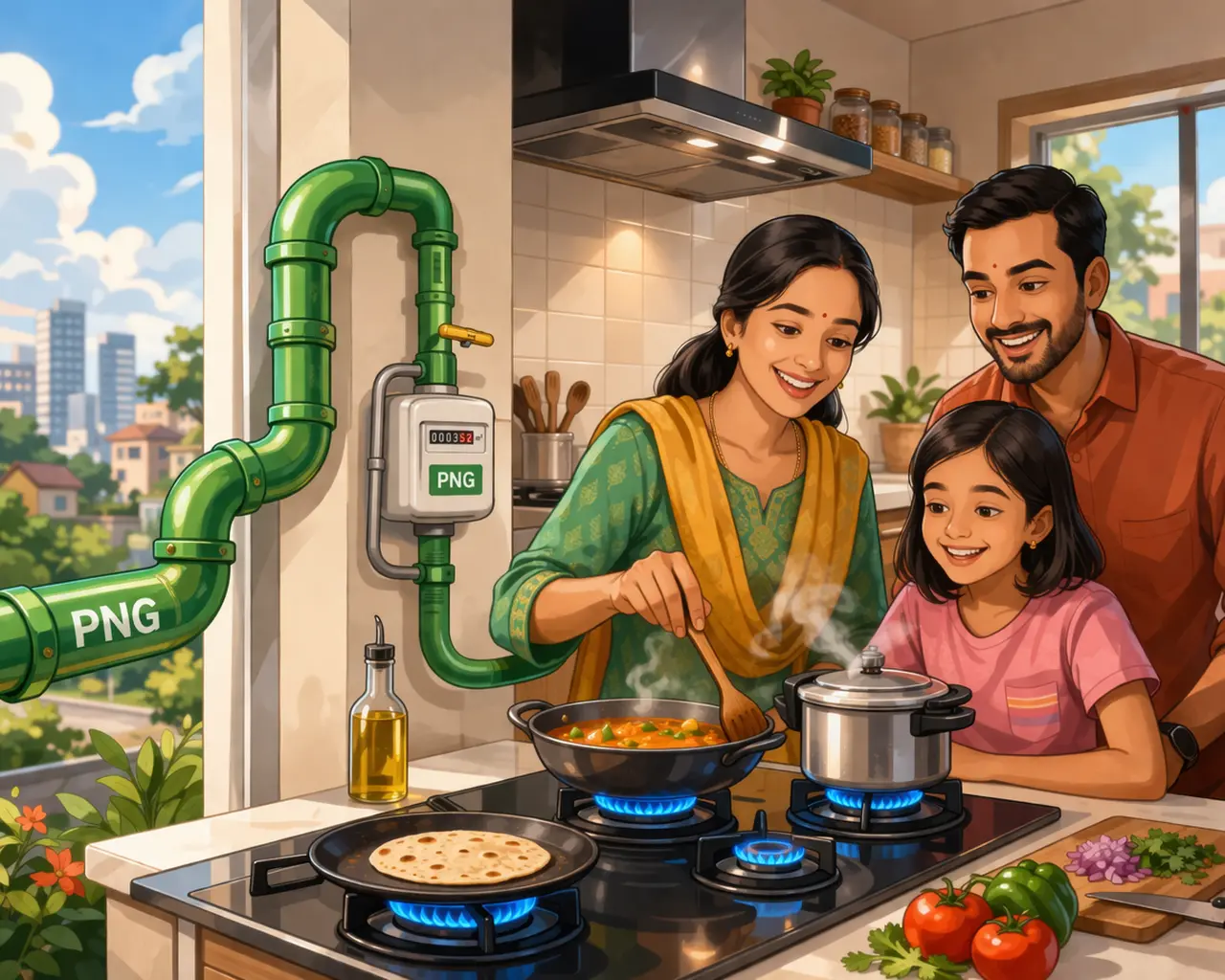
Most Indian households have grown up with the familiar red or blue cylinder sitting in the kitchen corner. LPG (Liquefied Petroleum Gas) is essentially propane and butane, compressed into liquid form, stored in those cylinders, and delivered to your door every few weeks. PNG {Piped Natural Gas} works completely differently. It is natural gas, mostly methane, that travels through an underground pipeline network directly into your home. A meter is installed at the entry point, and gas flows continuously to your stove on demand. No cylinder. No delivery. No waiting. The two fuels also behave differently in safety terms. LPG is heavier than air, which means if a cylinder leaks, the gas can accumulate at floor level and become a fire risk. Natural gas, on the other hand, is lighter than air and disperses upward quickly if there is a leak, reducing the risk of dangerous concentrations indoors.
Think of PNG like your electricity connection once the infrastructure is in place, you simply use what you need and pay at the end of the month. No refills, no deliveries, no storage.
Why Is the Government Pushing This Right Now?
The timing of this policy is directly connected to what is happening in the world right now. India imports approximately 60% of its LPG requirement, and nearly 90% of those imports travel through the Strait of Hormuz in the Persian Gulf. When geopolitical tensions in the region disrupted commercial shipping through the strait in early March 2026, India’s LPG supply chain came under sharp pressure almost immediately.
The government’s response has been two-pronged: manage the immediate shortage, and use this moment to accelerate a structural shift that was always needed. The PNG push is squarely part of the second objective. There are currently around 33 crore LPG households in India. But only about 1.62 crore of them are on PNG connections. Meanwhile, the government estimates that roughly 60 Lakh households already live in areas where PNG pipelines exist, yet continue to use LPG cylinders out of habit or inertia. The new order targets these households first, and they are the immediate priority.
What the New Order Actually Says :
The Natural Gas and Petroleum Products Distribution Order, 2026, issued under the Essential Commodities Act, does several things at once. Here is what matters most for households:
- If a PNG pipeline is available near your home and an authorised gas entity notifies you, you must apply for a PNG connection within the notice period.
- If you do not apply or switch within three months of being notified, your LPG supply to that address will be discontinued.
- If your housing society or RWA blocks the pipeline installation, LPG supply to the entire complex can be stopped after three months.
- The only exception: if the gas company certifies that a PNG connection is technically not feasible for your home, they will issue a No Objection Certificate (NOC), and your LPG supply continues.
- Dual connections holding both an active LPG and PNG connection simultaneously are prohibited going forward.
To ensure swift execution, the order mandates that housing societies and RWAs must Grant Right of Way permissions to gas companies within three working days of receiving an application. Once approved, gas companies must provide last-mile connections within 48 hours wherever technically possible.
The government has also removed a long-standing bottleneck: local authorities can no longer levy arbitrary charges or taxes on pipeline installation. Standardised fees have been prescribed, making approvals faster and more predictable.
What This Means for You Practically.
For households already in PNG-covered areas, the message is clear: do not wait for the notice to arrive and then scramble.
The smarter move is to check with your local gas distributor, whether that is IGL in Delhi, MGL in Mumbai, Adani Total Gas in Ahmedabad, or your city’s equivalent, about whether your locality is already in a notified zone. If you are in a covered area, applying early means you stay ahead of the rush. PNG applications have reportedly surged since the order was announced. Around 2.5 lakh new PNG connections were issued in March 2026 alone, with an equal number of applications pending. If you live in a housing society or apartment complex, it is worth raising this at your next RWA meeting. If your society blocks the pipeline installation, every resident in that complex risks losing LPG access after three months. Cooperation at the society level will save everyone from the disruption. For rural households and those in areas without pipeline infrastructure, there is no change. LPG will continue as normal, and the freed-up supply from urban areas transitioning to PNG will actually improve availability and reduce queues in those regions.
The Real Benefits of Making the Switch
Beyond the policy deadline, there are genuine, everyday reasons why PNG makes sense for urban households:
- No more booking hassle: No apps, no calls, no tracking deliveries. Gas is simply
always there when you turn on the burner. - No storage risk: A heavy pressurised cylinder in the kitchen carries inherent risk.
With PNG, there is no cylinder to store, handle, or worry about. - Lower cost over time: PNG eliminates multiple stages of the LPG supply chain import, bottling, transport, and delivery, each of which adds to the price. In most cities where both are available, PNG is cheaper per unit than LPG.
- Cleaner burning: Natural gas burns more efficiently and with fewer emissions than LPG, coal, or biomass, making it a better choice for air quality in kitchens and homes.
- Continuous supply: Unlike LPG, where you can run out mid-cooking and wait days for a refill, PNG is an uninterrupted flow as long as the grid is operational.
PNG is not just a convenience upgrade. It is a step toward energy independence for your household less dependent on global shipping routes, less dependent on cylinder supply chains, and more connected to India’s domestic gas infrastructure.
The Bigger Picture: India’s Long Road to a Gas-Based Economy
This policy push is part of a much longer ambition. The government has authorised 307 geographical areas across approximately 733 districts to develop city gas distribution networks, with a target of reaching 12.63 crore PNG connections by 2032.
As of early 2026, the number stands at around 1.62 crore, meaning there is enormous room to grow. The current disruption has done one thing clearly: it has accelerated a transition that was always going to happen, just more slowly. India cannot afford to have 60% of the fuel that powers 33 crore households remain dependent on a single global shipping chokepoint. The PNG infrastructure build-out is India’s answer to that vulnerability, one pipeline, one household, one city at a time. Natural gas is also widely seen as a bridge fuel in the journey toward renewables. It burns cleaner than coal and oil, produces fewer emissions, and can coexist with solar and wind in a diversified energy mix. By building out the national gas grid today, India is laying the foundation for an energy system that is more resilient, more affordable, and better positioned for the future.
What Should You Do This Week?
The action steps are straightforward:
- Check your city’s gas distributor website or app to see if your area is covered or
scheduled for PNG. - If you are in a housing society, speak to your RWA about facilitating a pipeline
Access delays at the society level affect every resident. - If you receive an official notice from your gas distributor, do not ignore it. Apply for the PNG connection promptly.
- If PNG is not yet available in your area, continue using LPG as normal. There is no impact on your supply.
- If you are unsure about feasibility, contact your local gas company and ask them
to assess your premises. They are legally required to certify infeasibility in writing if applicable.
The Kitchen of Tomorrow Is Already Here :
For generations, the LPG cylinder was as much a part of the Indian kitchen as the pressure cooker and the tawa. It served the country well, bringing clean fuel to hundreds of millions of households across every corner of India. But the world has changed. Supply chains are more fragile than anyone imagined. Energy security is no longer a policy document concern; it is a kitchen table reality. And infrastructure that was once a convenience is now a strategic necessity.
PNG is not a disruption to your home. It is an upgrade one that arrives quietly through a pipeline, removes the cylinder from your kitchen corner, and ensures the gas is simply always there when you need it. The transition is already underway. And for urban India, it is happening faster than most people realise.