
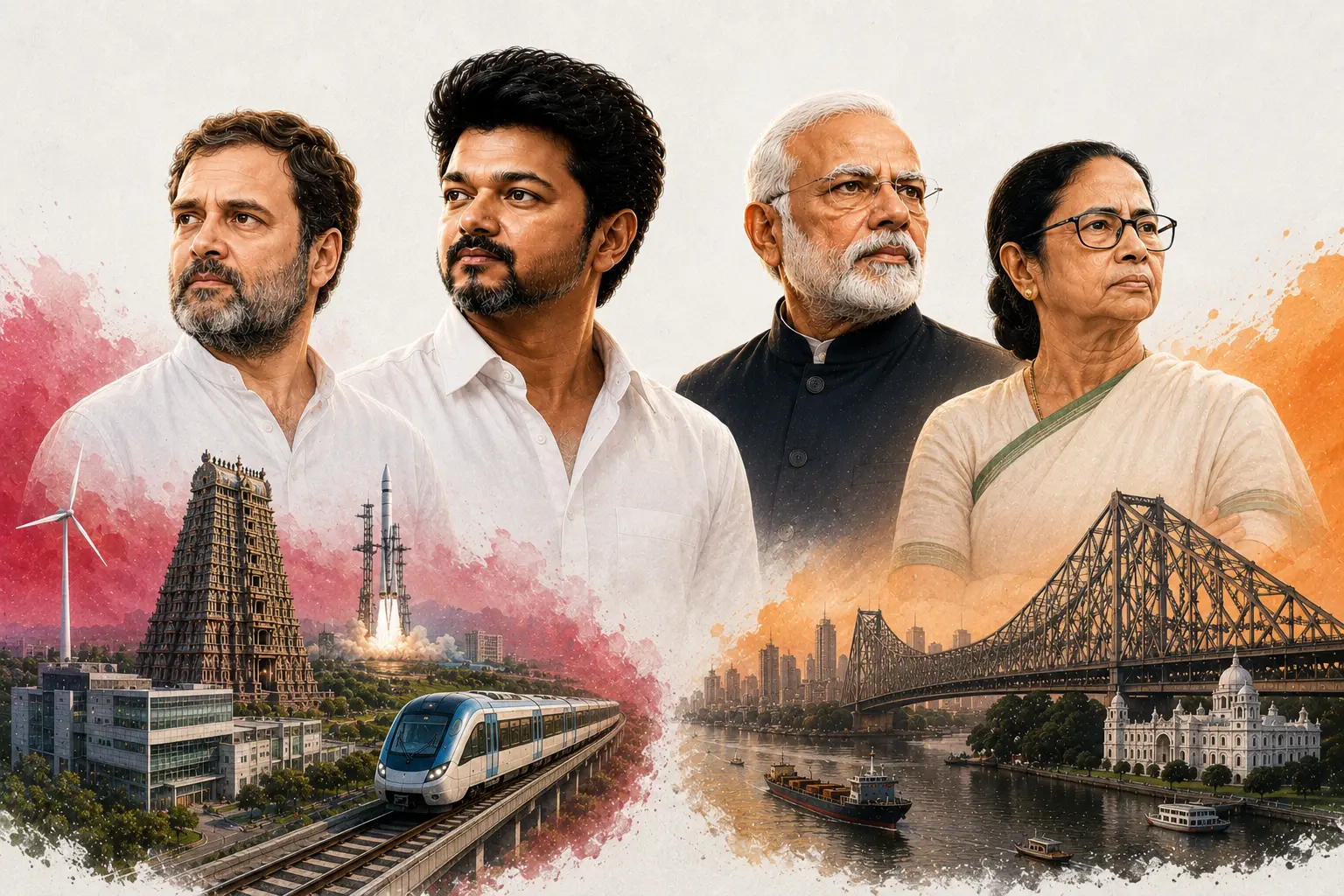
Two results. Two seismic upsets. On 4 May 2026, the BJP won West Bengal for the first time since state elections began in 1937, and a two-year-old party led by a film actor became the single largest party in Tamil Nadu, ending 59 years of Dravidian dominance. Here is what happened, why it matters, and what it means for India’s economy and business landscape in the years ahead.
India has seen many election surprises in its 75-year democratic history. Indira Gandhi losing her own seat in 1977. The BJP’s landslide in 2014. The unexpected AAP sweep of Delhi in 2015. But the results that came out of counting centres on 4 May 2026 belong in a category of their own. Two of India’s most historically resistant political fortresses fell on the same day, in the same counting cycle, within hours of each other.
In West Bengal, the Bharatiya Janata Party won 206 of 294 assembly seats, forming the state’s first right-of-centre government since assembly elections began in 1937. Mamata Banerjee, who had governed the state for 15 consecutive years across three terms and was widely regarded as one of India’s most formidable regional politicians, lost her own Bhabanipur seat to BJP’s Suvendu Adhikari by a margin of 15,105 votes. In a single evening, one of India’s most durable power structures was fundamentally altered.
In Tamil Nadu, something equally extraordinary happened. Actor Vijay’s party Tamilaga Vettri Kazhagam (TVK), which was formed only in February 2024 and had never contested an election before, won 108 of 234 assembly seats, emerging as the single largest party in the state. The DMK, which had predicted winning 200 seats just months earlier, was reduced to 73. Incumbent Chief Minister M K Stalin lost his own Kolathur constituency, a seat he had won three consecutive times. By the afternoon of 5 May, he had resigned. A two-year-old party led by a film star had, in a single election, ended a 59-year era of power alternating between the DMK and the AIADMK.
BJP won 206 of 294 seats in West Bengal, the first right-of centre government in the state since 1937. TVK won 108 of 234 seats in Tamil Nadu, ending 59 years of Dravidian dominance. Both results happened on the same day. Both were called impossible by most political analysts six months ago.
West Bengal: Why It Matters Beyond Politics
West Bengal is India’s sixth-largest state economy, with a projected Gross State Domestic Product of approximately 236 billion US dollars in 2025 to 2026. It is India’s gateway to the northeast, Bangladesh, Bhutan, and Southeast Asian trade routes. Kolkata is one of India’s most important financial and commercial centres. The state is India’s largest rice producer, the second-largest tea-growing state, and home to Haldia Port, which handles significant petrochemical and bulk cargo. For all of these reasons, who governs West Bengal matters enormously to businesses, investors, and supply chains far beyond the state’s borders. The campaign that led to this result was fought primarily on economic grounds. The BJP foregrounded jobs, industrial revival, and investment as its central arguments against 15 years of TMC rule. The issues that appear to have resonated most with voters were the school recruitment scandal, delays in government job examinations, concerns about law and order, and a perception that West Bengal’s investment climate had not kept pace with competing states like Tamil Nadu, Gujarat, and Odisha. The anti-incumbency that had been building since the 2024 R G Kar Medical College case provided additional momentum to a shift that was already underway.
For business and investment, the change of government in West Bengal carries significant implications. Global brokerage Citi, responding to the results, noted that markets would hope a strong political mandate and easier coordination with state governments would facilitate better implementation of various policy and process reforms. Morgan Stanley had flagged in April 2026 that India’s net foreign direct investment flows were near all-time lows, partly reflecting investor caution about governance quality in key states. A West Bengal government that actively competes for investment as the BJP campaign explicitly promised could change that calculation.
West Bengal holds structural advantages that have been underutilised for years. Its land borders with Bangladesh, Bhutan, and Nepal make it uniquely positioned for trade in a world where India is actively expanding its Act East connectivity. Petrapole, on the Bangladesh border, is one of the busiest land ports on the subcontinent. The Bengal Silicon Valley Tech Hub project, announced to create one lakh direct IT jobs, has been spoken about for years but has not been fully delivered. A change in government direction focused on ease-of-doing-business and investment attraction could unlock some of this potential, particularly in logistics, manufacturing, and technology.
The BJP’s victory also has a constitutional dimension that matters for business. The party now has close to a two-thirds majority in the Rajya Sabha, the upper house of Parliament. While experts note this still falls short of the mandate needed to pass the toughest structural reforms in the lower house, it gives the government significantly more legislative flexibility than it has had since 2024. For businesses watching policy reform timelines on labour laws, land acquisition, or privatisation, this shift in the parliamentary balance of power is relevant.
West Bengal has been one of India’s most underinvested large state economies for decades. Its geography, ports, and workforce are genuine assets. Whether a new government converts those assets into investment is the economic question that will define the state’s next five years.
What Drove the Bengal Result: Reading the Voter
The Bengal result was built on a remarkable voter turnout of 92.93% across the state the highest in West Bengal’s history, surpassing even the 2011 election that had brought Mamata Banerjee to power. In urban Kolkata, where turnout had historically been low, new polling booth arrangements in high-rise housing complexes significantly increased participation from residents who had previously stayed away. Women’s participation was described by the Election Commission as exceptionally high across the state.
The BJP’s 206-seat victory was broad-based across regions. The party performed strongly in urban Kolkata, in the Matua-dominated districts of North and South 24 Parganas, in Jungle Mahal in the southwest, and in districts along the Bangladesh border where CAA-related citizenship issues had been a live concern for years. The TMC, which had won 213 seats in 2021, was reduced to a fraction of its previous strength. Its chairperson lost her own seat. Several of her ministers lost their seats. The scale of the defeat was unusually large.
Tamil Nadu: The Historic End of the Dravidian Era
To appreciate the scale of what happened in Tamil Nadu on 4 May 2026, it helps to understand what the Dravidian era actually was. Since 1967, Tamil Nadu’s politics had been defined by an alternating duopoly between two parties founded on the philosophy of Periyar’s social reform movement: the DMK and the AIADMK. Every single state government for 59 uninterrupted years had been led by one of these two parties. No outsider had broken through. No new party had come close. The system was considered, by most analysts, to be structurally entrenched. TVK broke it in its very first election. The party, formed in February 2024 by actor Vijay, contested all 233 available constituencies alone, without a single alliance partner. It positioned itself explicitly as a rival to the DMK on corruption and governance grounds, while invoking the legacy of earlier Dravidian icons such as Annadurai and Periyar to establish cultural legitimacy. Vijay himself contested and won from two constituencies Perambur and Tiruchirappalli East an unusual but strategically deliberate move that demonstrated his personal electoral strength across different parts of the state. With 108 seats, the TVK was the single largest party but short of the 118-seat majority mark. The party facilitated an alliance with Congress MLAs, effectively integrating TVK into the INDIA bloc coalition framework, to form the new government. Vijay, at 51, is set to become Chief Minister of India’s second-largest state economy, a state that contributes 9.4% of national GDP, leads in electronics exports, automobile manufacturing, and textile production, and has been recording double-digit manufacturing growth. Media outlets drew comparisons to the rise of M G Ramachandran, the original actor turned Chief Minister who founded the AIADMK, and Jayalalithaa, who dominated Tamil Nadu politics for three decades. But the comparison only goes so far. MGR and Jayalalithaa came from within the Dravidian system. Vijay has broken it from outside. That distinction carries important implications for what kind of government Tamil Nadu might now see.
TVK was founded in February 2024. It had never contested an election. It had no sitting MLAs, no established cadre, and no government experience. In April 2026, it became the single largest party in India’s second-largest state economy. Analysts are still processing what that means.
What Drove TVK’s Victory: The New Political Consumer
The Wikipedia entry on the 2026 Tamil Nadu election offers a concise summary of what drove the TVK result. Analysts attributed the victory to anti-incumbency against the DMK government, Vijay’s successful mobilisation and conversion of his fan clubs into a unified political organisation, his perceived image as an underdog, TVK’s strong social media presence, a digital campaign portraying the party as a fresh and corruption-free alternative, and an inclusive candidate list that drew voters across caste and religious affiliations regardless of their previous political loyalties. The voters who shifted to TVK came from both the DMK and the AIADMK. The party pulled youth voters, women voters, urban voters, and first-time voters. In Chennai and Madurai, TVK captured approximately 30% of the urban vote share. The incumbent Chief Minister lost Kolathur a seat he had won three times to a first-time TVK candidate. The AIADMK’s general secretary Edappadi K Palaniswami retained his Edappadi seat with the widest winning margin in the state but his party’s overall tally collapsed. The voter had not moved to one established force. The voter had moved to the new force entirely.
For Tamil Nadu’s economy, the transition raises both opportunities and questions. The state enters this period with extraordinary economic momentum: 11.2% real GDP growth in 2024 to 2025, 52 billion US dollars in merchandise exports, Rolls-Royce and Hyundai investment commitments worth thousands of crores, and a stated target of becoming a one-trillion-dollar economy by 2030. The question for businesses and investors is whether a completely new government, with no legislative experience, can sustain and build on that trajectory while navigating the inevitable learning curve of governance.
The early signals matter enormously. Watch for how quickly the new government forms its cabinet. Watch for how it handles pending industrial investment proposals and global company commitments. Watch for the tone of its first budget. These signals will tell businesses far more about the next five years in Tamil Nadu than any campaign speech or victory rally.
The National Picture: What These Results Mean Across India
Taken together with the other results from this election cycle BJP retaining Assam, Congress returning to power in Kerala under UDF with a clear mandate, and AINRC
retaining Puducherry the May 2026 elections have produced a new political geography across five states that will shape national economic dynamics for the next five years.
The BJP’s West Bengal win gives Prime Minister Narendra Modi’s government a continuous belt of BJP-governed states along the Ganga from Uttarakhand through
Uttar Pradesh, Bihar, and now West Bengal that together represent a significant share of India’s infrastructure investment pipeline, agricultural output, and population. This geographic consolidation has implications for how central schemes are implemented, how infrastructure projects are coordinated, and how investment promotion is aligned between the centre and the states in this corridor.
In Kerala, the UDF’s return under Congress brings a change after five years of CPI(M) governance. Kerala’s economic strengths IT exports approaching one lakh crore rupees, the Vizhinjam deep-water port nearing completion, and remittance inflows remain structurally intact regardless of the government. The test for the new administration will be fiscal management and whether it can improve the state’s strained relationship with the central government on borrowing limits.
For the national business community, the cumulative message from these elections is that Indian voters in 2026 are making distinctly economic demands. In West Bengal, they chose a party that promised jobs and industrial revival over an incumbent who emphasised welfare schemes. In Tamil Nadu, they chose a completely new party over an incumbent who pointed to economic growth statistics. In both cases, the verdict reflected not just a judgment on the past five years, but an expression of where voters want the next five years to go.
These elections sent a clear message: Indian voters know what they want, and they are willing to deliver verdicts of historic scale to get it. Growth statistics are not enough if voters do not feel that growth in their own lives. That lesson applies as much to businesses as it does to governments.
What Businesses Should Watch in the Months Ahead
For businesses operating in or planning to enter West Bengal, Tamil Nadu, and the other states that just had elections, the next six months are critical for reading the direction of the new governments. There are three specific things worth watching closely. The first is cabinet formation. The speed and composition of the new cabinets will signal what each government’s actual priorities are. A West Bengal cabinet that gives prominence to industry, infrastructure, and investment portfolios will send a different signal than one dominated by law-and-order and political consolidation. A TVK cabinet in Tamil Nadu that retains or builds on the economic relationships established by the previous government will reassure investors. Both cabinets are scheduled to take oath in the coming days.
The second is the first state budget. Each new state government will present its first budget within months of taking office. These documents are the clearest signal of fiscal priorities whether the government plans to increase capital expenditure on infrastructure, whether it prioritises welfare spending, and whether it has a credible plan for managing the state’s finances. West Bengal’s fiscal health has been a concern for investors. Tamil Nadu has maintained disciplined fiscal management. Watching whether that discipline is maintained under new leadership is important.
The third is the handling of existing investment commitments. Tamil Nadu has significant pending commitments from global companies Rolls-Royce, Hyundai, and others, who signed agreements with the previous government. How the new government confirms, renegotiates, or honours these commitments will be watched closely by every company considering entering the state. West Bengal has a shorter pipeline of confirmed commitments, but the BJP’s stated focus on industrial revival means its early actions on investment will be closely scrutinised.
The Honest Summary
What happened on 4 May 2026 is genuinely historic. The BJP ending 89 years of non right-of-centre governance in West Bengal is a fact without precedent in modern Indian political history. A two-year-old party led by a film actor ending 59 years of Dravidian dominance in Tamil Nadu is equally without precedent. Both events happened on the same day. The economic implications are real but uncertain. West Bengal has structural advantages geography, ports, agricultural wealth, a large and educated workforce that have been underutilised for decades. A government genuinely focused on investment and industrial revival could begin to unlock them. Tamil Nadu has extraordinary economic momentum that needs to be sustained through a government transition by a party with no prior governance experience. In both cases, the voters made their choices clearly and decisively. The responsibility for what comes next rests entirely with the governments they have elected. India’s economy and business community will be watching and making decisions based on what they see from the very first week.
The ballots have been counted. The results are historic. Now the real work begins.